
Local AI's 'Consumer Moment': Running 125B Models on Gaming Hardware

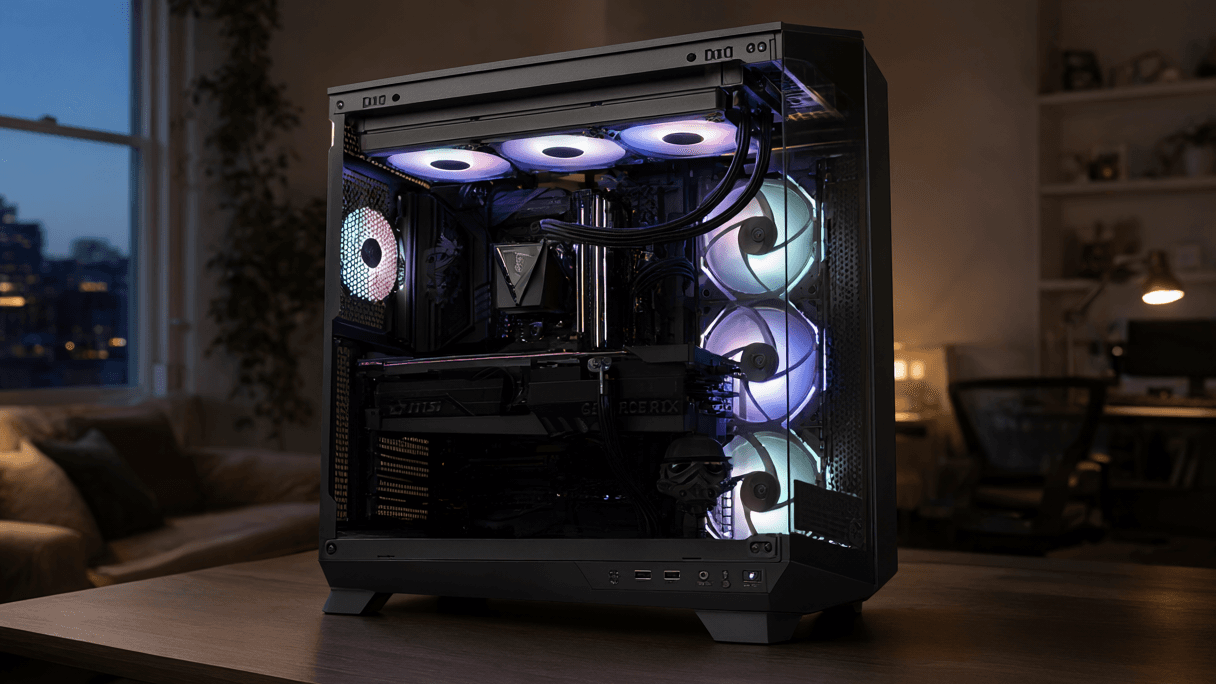
AI-generated image · Bay Street Wire
The arrival of Strata proves that massive, server-grade AI models are no longer restricted to the cloud—they're officially viable on the home PC.
For years, the dream of running a truly powerful Large Language Model (LLM) locally has felt like a hobbyist's pursuit, characterized by sluggish response times and hardware requirements that mirrored a small data center. But we are hitting a tipping point.
As first reported via the Strata project on Hacker News, it is now possible to run a 125-billion-parameter AI model—specifically Qwen3.8-Flash-Next—on a standard gaming PC. This isn't just a technical curiosity; it is a shift in the consumer reality of AI. When you can take a model that typically requires a server and run it on an NVIDIA RTX 5070 or an AMD RX 9070 XT, the 'toy' phase of local LLMs is officially over.
**The Hardware Threshold**
Strata's requirements are surprisingly accessible for anyone who has kept up with GPU cycles. The software supports NVIDIA GeForce RTX 20, 30, 40, and 50 series, as well as various AMD Radeon RX cards (including the 7900 XT/XTX and 9070 XT). The baseline requirement is 12 GB of VRAM and at least 32 GB of system RAM.
In my view, the real unlock here is the efficiency of the implementation. Strata allows these massive models to function by leveraging different compression sizes. For example, a user with 64 GB of RAM can run the IQ3_S size, while those with 32 GB can utilize the 'Coder' version—a specialized model that, according to the model's authors, retains 91% of the full model's SWE-bench Verified score but fits within a tighter memory footprint.
**Performance: Beyond the Benchmark**
Speed is where the 'consumer reality' becomes tangible. According to Strata's measurements on an NVIDIA RTX 5070 (paired with a Ryzen 5 7600 and 64 GB RAM), the system can hit speeds of 94 tokens per second using the Q2_0 size. Even the smarter, slower IQ3_S size clocks in at 53 tokens per second. For context, Strata notes that 60 tokens per second is faster than the average human can read.
If you push the hardware further, the gains are significant. Strata reports that an RTX 3090 with 24 GB of VRAM should be capable of writing between 100 and 140 tokens per second. This level of responsiveness transforms the AI from a slow, deliberative tool into a fluid extension of the user's workflow.
**Privacy and Utility**
Beyond the raw speed, the value proposition is the total localization of data. Strata emphasizes that "nothing leaves your PC." This allows the model to chat, write code, and read images locally. Furthermore, the project integrates with modern developer workflows via an MCP server, allowing AI coding assistants like Cursor, GitHub Copilot, and Claude Code to install and manage Strata directly.
We are seeing the convergence of high-end consumer hardware and aggressive model optimization. When a 125B model can be deployed via a simple `.bat` file on Windows or a `.sh` script on Linux, the barrier to entry has vanished. Local AI is no longer about seeing if it *can* work; it's about how much you can do with it.