
The Tiny Home Trap: Toronto's 'Quirky' Real Estate is a Symptom of Desperation

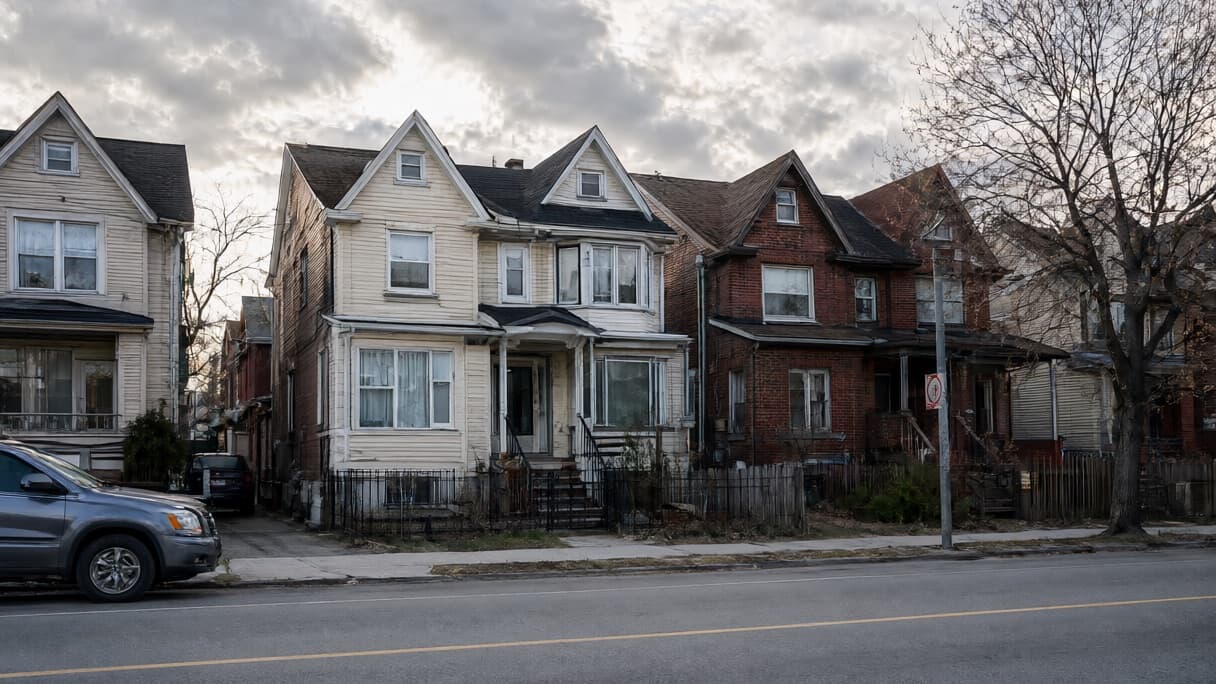
AI-generated image · Bay Street Wire
Opinion: While some frame Toronto's narrowest homes as architectural curiosities, they are actually evidence of a housing market that forces residents into suffocating compromises.
In the glossy world of real estate marketing, we are often told that 'size isn't everything.' As BlogTO first reported, we see stories about 'The Little House' at 128 Day Ave., a 312-square-foot miniature property that once appeared on *The Ellen DeGeneres Show*, and we are encouraged to view these spaces as charming anomalies. But as a columnist covering the cost of living, I see these properties for what they actually are: desperate attempts to carve out a sliver of ownership in a city where the housing market is fundamentally broken.
When we look at the examples highlighted by BlogTO, the 'quirkiness' quickly evaporates. Take 383 Shuter Street in Cabbagetown. This detached home, which BlogTO notes was marketed as the city's narrowest, has a lot measuring just eight feet wide—roughly the width of a standard parking space. In 2023, it was listed for over $1 million. While it eventually sold in 2024 for $830,000, the fact that a home where you can 'practically touch both exterior walls at the same time' commands nearly a million dollars is not a testament to architectural ingenuity; it is a testament to a crisis.
We are being sold a narrative of 'small-space living' as a lifestyle choice, but the reality is often a matter of survival. Consider 1024A Shaw Street. According to a 2023 submission to the City of Toronto cited by BlogTO, this dwelling is only 6.5 feet wide and measures approximately 400 square feet. Like 128 Day Ave.—which contractor Arthur Weeden built in 1912 on a strip of land intended for a driveway—the Shaw Street property may have also been built in a former driveway. When we start treating driveways as viable residential lots, we aren't witnessing a 'trend'; we are witnessing a collapse of affordable space.
Some might argue that these homes provide a necessary alternative to the 'shoebox condo.' 229 Winnett Ave. in Humewood-Cedarvale, for instance, offers a 10-foot-wide footprint with an open-concept layout and heated basement floors. But for most people, the trade-off is grueling. The desperation reaches its peak with properties like 30 Hanson Street. When listed in 2013 for $195,000, BlogTO reports this 210-square-foot detached home had neither a kitchen nor a bathroom. While the price tag seems like a dream today, the reality of living in a space smaller than a garage without basic plumbing is a far cry from a 'lifestyle choice.'
Toronto has a century-long history of squeezing houses into any available gap, but we can no longer afford to romanticize this. When a home the size of a hallway is marketed as a luxury or a 'functional' alternative, the market is no longer serving the people; it is merely exploiting their need for shelter. These tiny homes aren't architectural triumphs—they are the physical manifestation of a city where the dream of homeownership has been shrunk down to a size that is barely livable.