
The Great HOV Surrender: Why Opening Lanes to Solo Drivers is a Traffic Trap
AI-generated image · Bay Street Wire
Opinion: The Ford government's plan to allow single-occupant vehicles into HOV lanes during off-peak hours isn't a solution to gridlock—it's a dismantling of the only incentive we have to carpool.
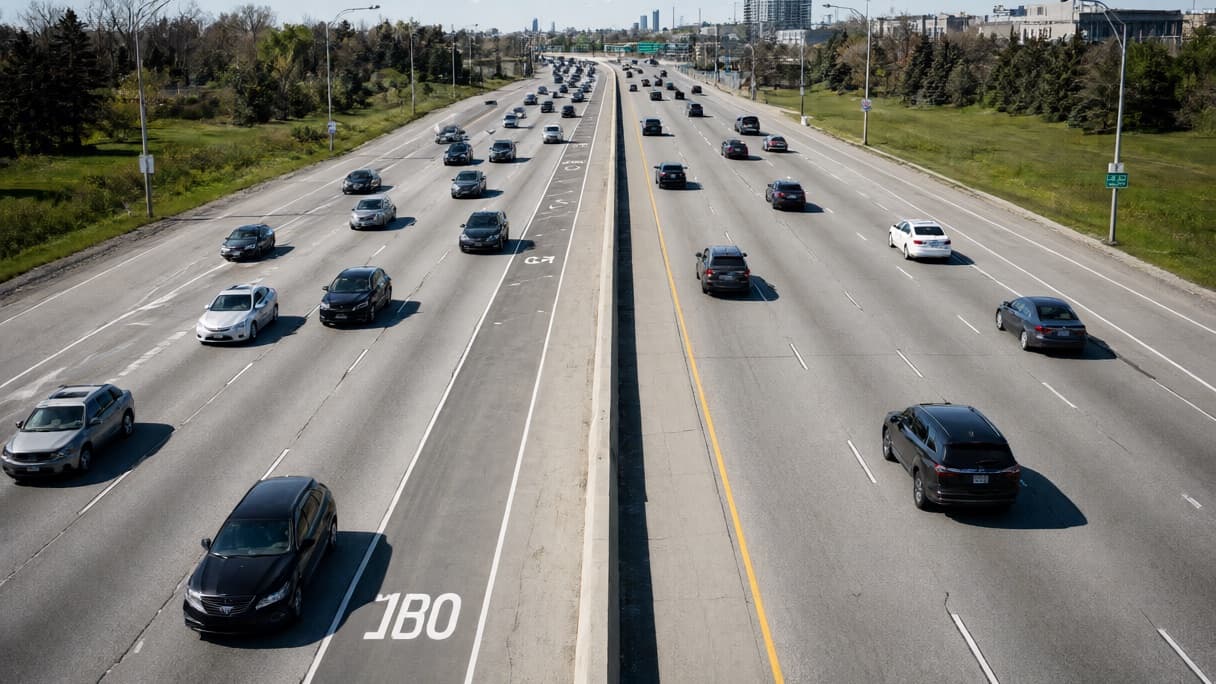
The Ford government is selling us a fantasy of efficiency. According to reporting from CBC Toronto and CityNews Toronto, starting January 1, 2027, Ontario will open high-occupancy vehicle (HOV) lanes to single-occupant vehicles during off-peak hours. The schedule is specific: Monday through Friday from 10 a.m. to 2 p.m. and 8 p.m. to 6 a.m., and weekends from 9 p.m. to 9 a.m.
Minister of Transportation Prabmeet Sarkaria argues that drivers shouldn't be stuck in traffic while room is available in the HOV lane. Dakota Brasier, a spokesperson for the ministry of transportation, claims this makes "better use of existing highway infrastructure." On the surface, it sounds like common sense. Why leave a lane empty? But as any contrarian will tell you, the shortest path to a result is rarely the most sustainable one.
This isn't a strategic optimization; it is a surrender. For years, the HOV lane served as a tangible reward for those willing to coordinate their lives with others to reduce the number of cars on the road. By eroding these boundaries, the government is effectively telling drivers that the sacrifice of carpooling is no longer necessary.
Jeffrey Casello, a professor of transportation planning and engineering at the University of Waterloo, provided a critical perspective in an interview with CBC News. He noted that we have already been incrementally expanding access—adding motorcycles in 2019 and green-plated vehicles in 2016. Casello warns that this latest move will likely motivate people who previously carpooled to feel comfortable traveling alone, which will only serve to increase congestion.
When you remove the incentive to share a ride, you don't get "better flow"; you get more cars. The province claims that traffic modelling shows this change will decrease congestion in both HOV and general-use lanes, but as Ontario NDP Leader Marit Stiles pointed out to CBC Toronto, the public hasn't seen the expert reports backing this up. Stiles questioned if this policy is based on data or if it's simply the result of Premier Doug Ford noticing an empty lane during a morning commute.
Let's be clear: the HOV lane was designed to be a priority corridor, not a relief valve for poor planning. By opening these lanes, the government is treating the symptom—a momentarily empty lane—while exacerbating the disease: a culture of single-occupancy commuting.
If the goal is truly to reduce gridlock, the solution is to make carpooling more attractive, not to make solo driving more convenient. Once you start treating the HOV lane as just another lane for anyone who feels like using it, you've killed the only tool we had to actually get cars off the road. We aren't "getting drivers moving"; we are just inviting more of them to join the jam.