
The Great Hardware Unlock: How 'Vibe Coding' is Breaking the Synth Walled Garden

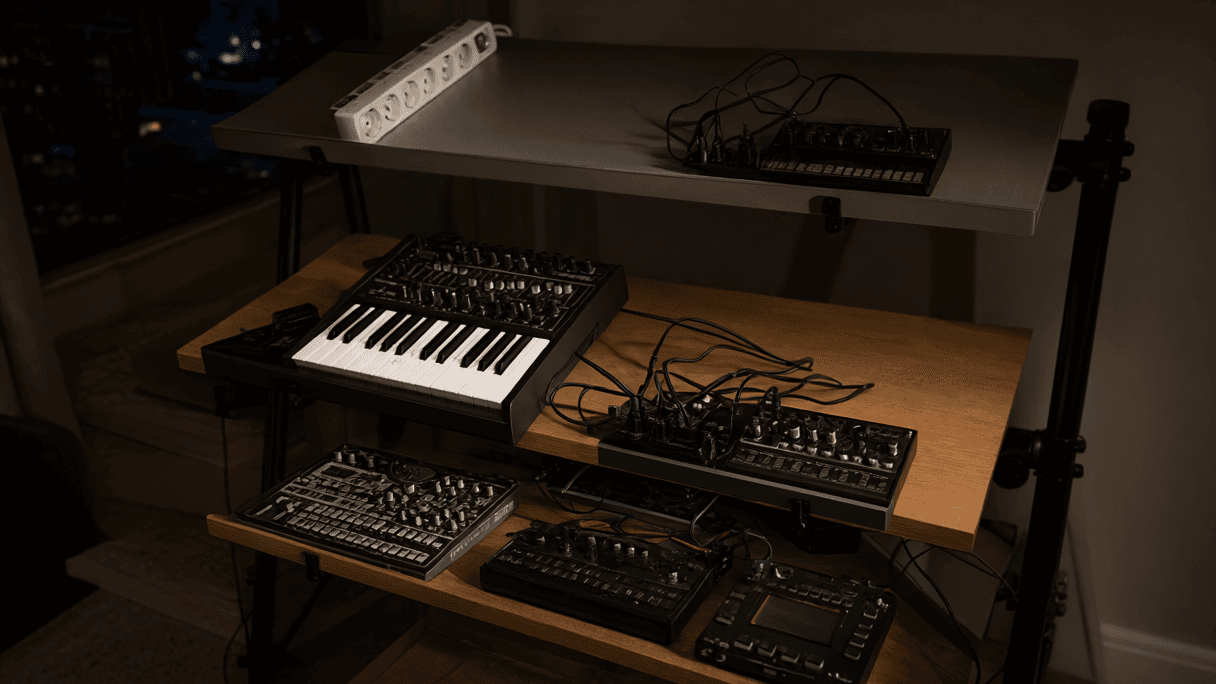
AI-generated image · Bay Street Wire
AI-driven custom firmware is transforming budget gear and legacy hardware into powerhouse studios, bypassing manufacturer limitations.
For years, the hardware synth world has been defined by rigid boundaries. If a manufacturer decided a feature didn't belong on a budget device, that was the end of the story. But as first reported by The Verge, we are seeing a massive shift. A phenomenon known as 'vibe coding'—using Large Language Models (LLMs) to write code—is effectively dismantling the walled gardens of music hardware.
According to reporting from The Verge, the barrier to entry for custom firmware has collapsed. In the pre-LLM era, adding a simple feature like velocity sensitivity to a Korg Volca could take weeks or months of deep technical labor. Now, hobbyists are using tools like Claude to overhaul gear in a matter of days.
**The Budget Revolution** Nowhere is this more evident than with the M-Vave FM-1, a $70 Yamaha DX-7 clone. The Verge reports that this dirt-cheap device has become the center of an AI-driven arms race. While it started as a basic clone, custom firmwares like Sloop, Felucca, and x0x—which explicitly credit Claude on GitHub—have expanded its capabilities. The FM-1 now supports multi-track sequencing, sample playback, virtual analog synth engines, and various UI designs.
**Reviving Legacy Gear** It isn't just the new budget gear getting a boost; legacy hardware is being breathed back to life. The Verge highlights Roman Rusinov (known as themanro on Reddit and Farlow as a musician), who used vibe-coding to push a 2012 Zoom MS-70CDR multi-effects pedal. By utilizing the ZDL reverse-engineering project, Rusinov coaxed the pedal into running custom impulse responses (IRs) and NAM A2 Lite captures, effectively turning a budget pedal into a vintage amp modeler.
**Fighting Planned Obsolescence** Some developers are using these tools to fight back against manufacturer limitations. 18nelli, the creator of Modded Cycles, told The Verge he felt the Elektron Model:Cycles was designed to push users toward more expensive equipment. Since the device hasn't seen an official update since May 2021, 18nelli used Claude Code to implement six-track audio over USB. This has evolved into a community project that can even transform a Model:Cycles into a Model:Samples.
**The Broad Impact** The scope of this movement is staggering. The Verge notes that in just the last month, custom firmware has emerged for a wide array of devices, including: * **Elektron:** Digitone, Octatrack, Digitakt, and Model:Cycles * **Roland:** SP-404 MKII * **Ableton:** Push 3 and Move * **Akai:** MPC One, MPC Live, and the vintage MPC 2000 * **Other:** Novation Circuit, Arturia MicroFreak, and Zoom's Multistomp line.
*Opinion: This is the most exciting era for the home studio in a decade. We're moving from a world where we are passive consumers of hardware features to one where the community decides what a piece of gear can actually do.*