
The Art of the Chaos: Why Nuit Blanche is Toronto's Greatest Act of Urban Reclamation

AI-generated image · Bay Street Wire
Opinion: Two decades in, the city's all-night art crawl has evolved from a curated gallery experience into a vital, sleepless ritual of reclaiming our streets.
For twenty years, Toronto has engaged in a peculiar, collective insomnia. What began in 2006 as a daring experiment in public art has morphed into something far more significant than a mere exhibition. As we reflect on the 2026 iteration of Nuit Blanche, it is time to admit that the 'art'—while present and provocative—is no longer the primary draw. The true masterpiece of Nuit Blanche is the way it allows us to reclaim the city from the rigid structures of the work week.
As BlogTO first reported, the 2026 festival marked the 20th anniversary of this annual city-wide all-night art crawl. Spanning from a Saturday night into Sunday morning, the event featured more than 70 installations scattered across downtown Toronto. To the casual observer, these abstract installations are the point of the exercise. But to those of us who have walked these streets for two decades, the installations are merely the anchors for a larger, more chaotic social phenomenon.
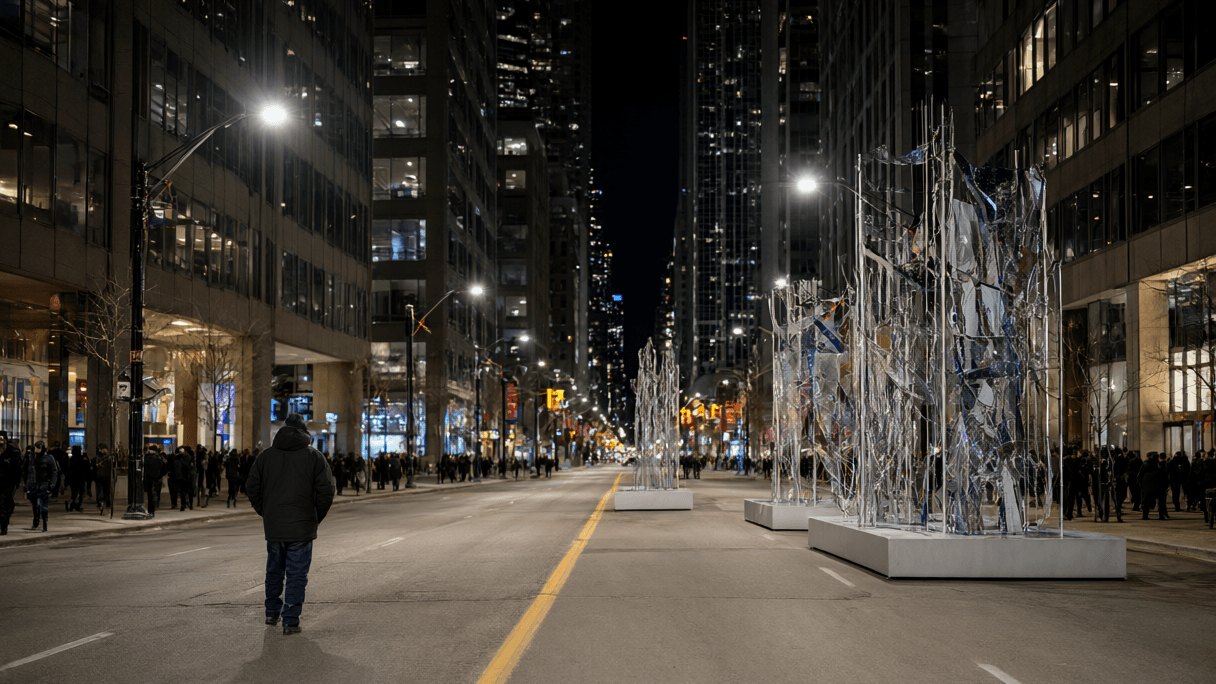
In a city often defined by its commuters' rush and the sterile efficiency of its financial district, Nuit Blanche offers a rare rupture. For one night, the geography of downtown is rewritten. The streets are no longer conduits for traffic or paths to an office; they become a playground. When BlogTO describes the transformation of Toronto's landmarks and streets, they are describing a temporary utopia where the city belongs to the wanderer rather than the driver.
There is a specific kind of energy that emerges when thousands of people decide to ignore the biological imperative of sleep in favor of curiosity. The 'crawl' aspect of the event is essential. By spreading over 70 installations across the downtown core, the festival forces a physical engagement with the city. We are pushed into corners of the downtown we might otherwise ignore, guided by the glow of an abstract sculpture or the curiosity of a crowd.
Critics often argue over the merit of the specific pieces on display, but that misses the forest for the trees. Whether an installation is a triumph or a curiosity is irrelevant to the experience of the night. The success of Nuit Blanche is measured not in the critical acclaim of its art, but in the volume of people willing to occupy the public square at 3:00 a.m. It is an act of urban reclamation. For a few fleeting hours, the city is not a place of commerce or transit, but a place of shared, sleepless discovery.
Even as the main event concludes, the lingering impact remains. BlogTO notes that a selection of 11 exhibits have been granted extended display through Saturday, Oct. 10, 2026, allowing the spirit of the night to bleed into the following week. This extension serves as a reminder that the desire to see our city transformed is not something that can be contained within a single twelve-hour window.
Twenty years in, Nuit Blanche has become a fall tradition that defines the Toronto identity. It is our collective refusal to let the city sleep, a chaotic embrace of the abstract, and a reminder that the streets belong to the people. The art brings us out, but the reclamation is why we stay.