
The Twenty-Year Mirror: Why Nuit Blanche is the Ultimate Test of Toronto's Public Soul

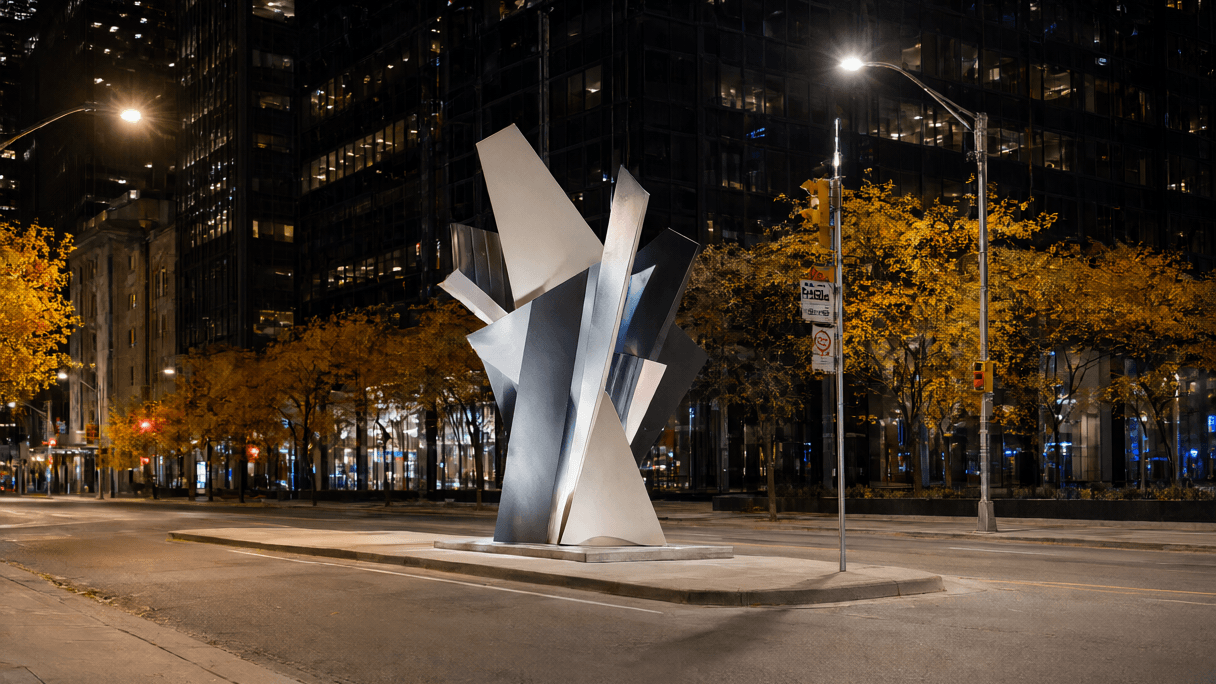
AI-generated image · Bay Street Wire
Opinion: Two decades after its inception, the city's annual all-night art crawl has evolved from a mere event into a vital measurement of how we reclaim and inhabit our urban spaces.
For twenty years, Toronto has engaged in a peculiar, nocturnal ritual. What began in 2006 as a daring experiment in urban art has morphed into a definitive annual litmus test for our city. Nuit Blanche is no longer just an art crawl; it is the moment we collectively decide how to inhabit and reclaim the public spaces of Toronto.
As reported by BlogTO, the 2026 iteration of the festival marked its 20th year, transforming downtown streets and landmarks with abstract installations from Saturday night into Sunday morning. With over 70 installations spread across the city, the event serves as a massive, immersive intervention in the daily grind of urban life. When we step out into the autumn chill to witness these works, we aren't just viewing art—we are renegotiating our relationship with the concrete and steel that defines our existence.
There is something profoundly symbolic about the scale of this event. CBC Toronto notes that Nuit Blanche is a 12-hour exhibition featuring more than 70 projects. This isn't a curated gallery experience where the boundaries are clear and the behavior is prescribed. Instead, it is an expansive, city-wide takeover. By decentralizing the art and scattering it across the downtown core, the festival forces us to engage with the city as a living canvas rather than a series of commutes and destinations.
In my view, the true value of Nuit Blanche lies in this reclamation. For one night, the functional nature of the city—the transit corridors, the corporate plazas, the quiet residential pockets—is suspended. We stop moving through the city to get somewhere else and start moving through it to be somewhere. The fact that 11 of these exhibits remain on extended display through Saturday, Oct. 10, 2026, as detailed by BlogTO, suggests a growing desire to let these artistic interventions linger, challenging the temporary nature of our public interactions.
Critics might argue that a twenty-year-old tradition risks becoming predictable, but the sheer volume of work—over 70 projects, as cited by CBC Toronto—ensures that the dialogue remains dynamic. Each year, the festival asks: *Who owns the street? Who is allowed to occupy this space, and for what purpose?*
When we see abstract installations disrupting the familiar geometry of our landmarks, we are reminded that the city is malleable. Nuit Blanche proves that Toronto can be more than a hub of commerce and transit; it can be a site of immersive, shared wonder. It is the one night a year where the city's public spaces are reclaimed not for utility, but for curiosity.
Twenty years in, Nuit Blanche has become the mirror in which we see our city most clearly. It is a testament to the idea that art should not be confined to white walls, but should instead bleed into the streets, forcing us to look at our environment with fresh eyes. As we move forward, the success of the festival will not be measured by the number of installations, but by how effectively it continues to challenge us to inhabit our city more fully.