
The AI Hardware Treadmill: Why the 'Green' Narrative is a Toxic Fantasy

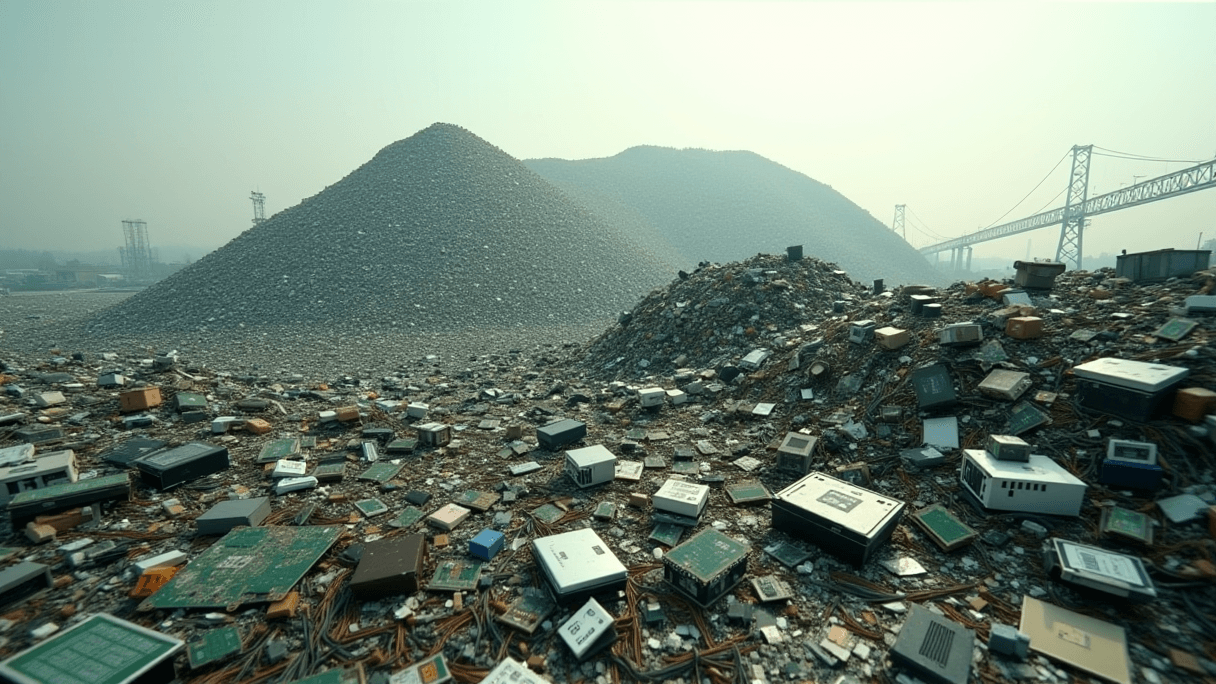
AI-generated image · Bay Street Wire
Industry leaders speak of optimization, but a new report from the Basel Action Network reveals a looming 'waste tsunami' of hardware that no amount of software efficiency can erase.
### The Weightless Illusion
In the current corporate narrative, artificial intelligence is often presented as a weightless miracle—lines of code and ethereal neural networks processing data in a cloud. But as a skeptic of the industry's self-reported sustainability metrics, I find the 'green' AI trajectory to be less of a roadmap and more of a fantasy. As The Verge first reported, the reality is that every Large Language Model (LLM) is anchored to a massive, physical footprint of specialized hardware that is destined for the scrap heap.
While the industry focuses on software optimization and energy efficiency, it ignores the physical waste crisis created by the hardware treadmill. We are not just building intelligence; we are building a mountain of toxic debris.
### Beyond the GPU: The Hidden Infrastructure
For too long, the conversation around AI's environmental impact has been narrow, focusing primarily on servers and GPUs. However, reporting from The Verge highlights a critical blind spot in these calculations. According to the nonprofit Basel Action Network (BAN), previous studies that focused only on accelerators and servers missed approximately 87 percent of a data center's electro-mechanical infrastructure.
To understand the true scale of the problem, one must look at the entire supporting ecosystem. BAN's latest research expands the definition of AI waste to include: * Power supply and distribution systems * Cooling infrastructure * Backup power systems * Networking equipment
Jim Puckett, the founder and chief of strategic direction at BAN, warns that the current AI buildout could evolve into a "cataclysmic toxic waste crisis" if governments and corporations fail to plan for what he describes as a "waste tsunami."
### The Math of a Waste Tsunami
When the scope is widened to include this supporting infrastructure, the numbers become staggering. BAN estimates that for every gigawatt of data center capacity, 70,000 metric tons of e-waste are generated. This figure is particularly alarming when paired with a McKinsey projection that total data center capacity could reach 219GW by 2030.
Based on these projections, BAN concludes that AI-related electronic equipment retired between 2025 and 2050 will result in between 395 million and 617 million metric tons of e-waste. On an annual basis, this translates to roughly 8.6 million to 13.1 million metric tons of hardware reaching retirement.
To put this in perspective, BAN suggests that by 2050, the resulting trash could fill 23 million shipping containers—enough 40-foot containers to circle the globe six times. While global e-waste is predicted to triple to 211 million metric tons per year by 2050, BAN attributes roughly 15 to 20 percent of that total specifically to AI.
### The 'Contagion' Effect
Perhaps the most insidious part of the AI hardware cycle is what BAN terms "AI Waste Contagion." This category recognizes that the AI boom doesn't just create waste within the data center; it accelerates obsolescence across the entire consumer electronics ecosystem.
As AI advances, telecommunications infrastructure and personal devices are likely to be replaced more frequently, as older hardware becomes incapable of supporting new AI-driven features. This creates a feedback loop where the drive for "smarter" devices leads to a faster churn of hardware, further bloating the global waste stream.
### A Crisis of Accountability
The tragedy of this hardware treadmill is that the world is fundamentally unprepared to handle the volume of waste. The Verge reports that less than a quarter of the 68.3 million tons of e-waste produced globally each year is formally collected and recycled.
Instead, the majority of this equipment enters "informal" waste collection streams. In these shadowy operations, equipment is often burned or buried, exposing workers and the environment to hazardous materials such as chromium and lead. The World Health Organization has noted that millions of children living or working near these sites face severe health threats.
Adding to the systemic failure is the role of the United States. Despite having more data centers than any other nation, the U.S. has not ratified the Basel Convention, an agreement designed to limit the international trade of hazardous wastes. Investigations have revealed that U.S. recyclers continue to ship e-waste abroad, where it frequently ends up in "backyard recycling" operations.
### The Bottom Line
The industry can talk about "green AI" all it wants, but you cannot optimize away the physical reality of a server rack. When we account for the cooling systems, the power distribution, and the accelerated obsolescence of consumer devices, the AI revolution looks less like a leap forward and more like a race toward a toxic cliff. Until the hardware lifecycle is addressed with the same intensity as the model's parameters, the "green" narrative remains a corporate fiction.