
Ambrosia's Texas Battery Bet: A Blueprint for Decoupling AI from Fossil Fuels

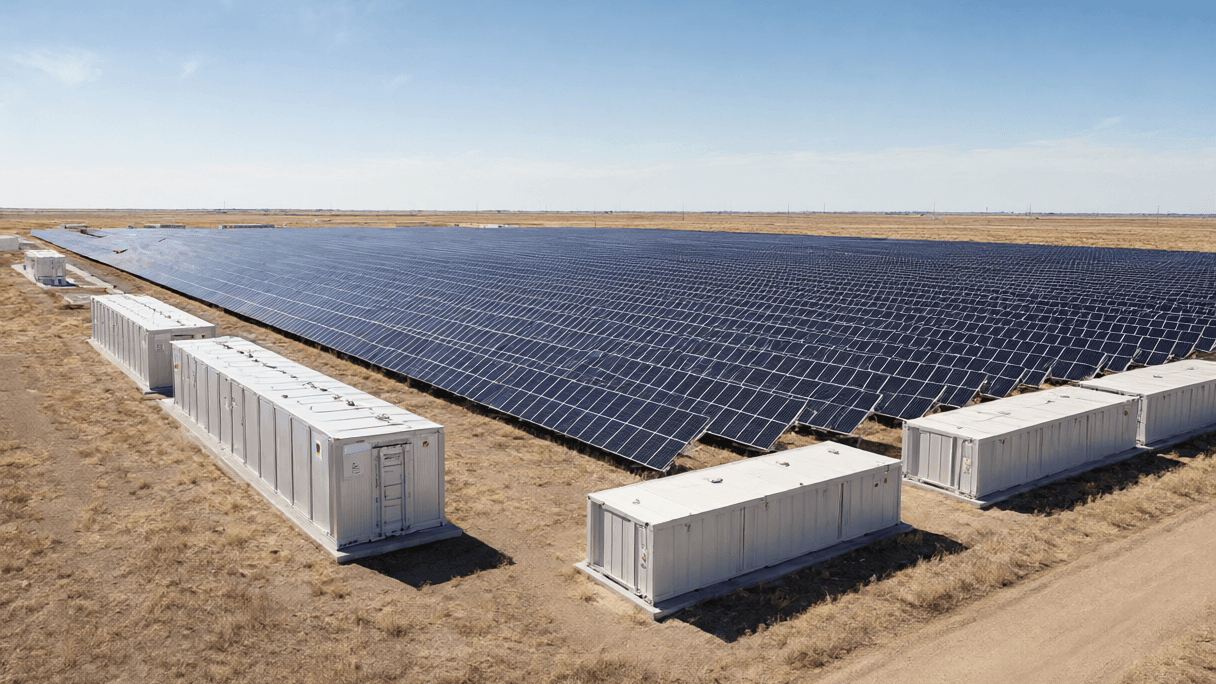
AI-generated image · Bay Street Wire
By scaling in-house battery production and deploying off-grid solar plants, Ambrosia Energy aims to undercut the natural gas turbines currently fueling the data center boom.
For too long, the narrative surrounding the AI data center explosion has been one of reluctant dependence on the fossil fuel grid. To truly decouple this growth from carbon, we need more than theoretical breakthroughs; we need tangible, industrial-scale deployment. As TechCrunch first reported, that is exactly what Ambrosia Energy is attempting with its latest move into Texas.
**The Industrial Play** According to reporting from TechCrunch, Ambrosia Energy CEO and co-founder Ben Longmier announced at TechCrunch Disrupt in San Francisco that the company is constructing a 150,000-square-foot battery factory near Austin, Texas. The facility is designed for a 10 gigawatt-hour capacity, which Longmier states will enable the company to build approximately one 300-megawatt power plant per year at their field sites. The startup expects to reach full production within two to three years.
**The Deployment Strategy** Ambrosia is not just building a factory; it is deploying the hardware. The company is slated to start construction on its first commercial power plant in West Texas later this year, according to TechCrunch. This facility will combine 300 megawatts of solar panels with 660 megawatt-hours of battery storage to provide 30 megawatts of continuous power, targeting an uptime of 99.3%.
To prove the concept, Longmier noted that sections of a pilot-scale plant have already operated continuously for over 100 days, generating 200 kilowatts of electricity 24/7.
**The Economics of Off-Grid Power** Opinion: The most critical part of this play is the cost. For clean energy to win, it cannot rely on subsidies alone; it must be the cheapest option. Ambrosia is targeting a cost of $100 per megawatt hour—a price point Longmier claims is competitive with the natural gas turbines that many hyperscalers currently plan to use.
To hit these targets, Ambrosia is aggressively simplifying its hardware. Longmier told TechCrunch that by manufacturing components in-house and reducing part counts, the company has created battery packs with significantly fewer parts than competitors. Specifically, Longmier stated that their packs have the fewest parts by a factor of about 100 compared to other competitors, allowing them to reach a cost of roughly 1.3x the bare cell, whereas most stationary storage systems range from 5x to 7x.
Founded by Longmier and co-founder Sara Spangelo—who previously started the satellite company Swarm before selling it to SpaceX—Ambrosia emerged from stealth in June. Their thesis is simple: solar plus batteries is the fastest and cheapest path to powering the AI revolution without tethering it to the grid.