
Where Walls Meet Sky: Art Blooms from the Ruins of St. Anne’s

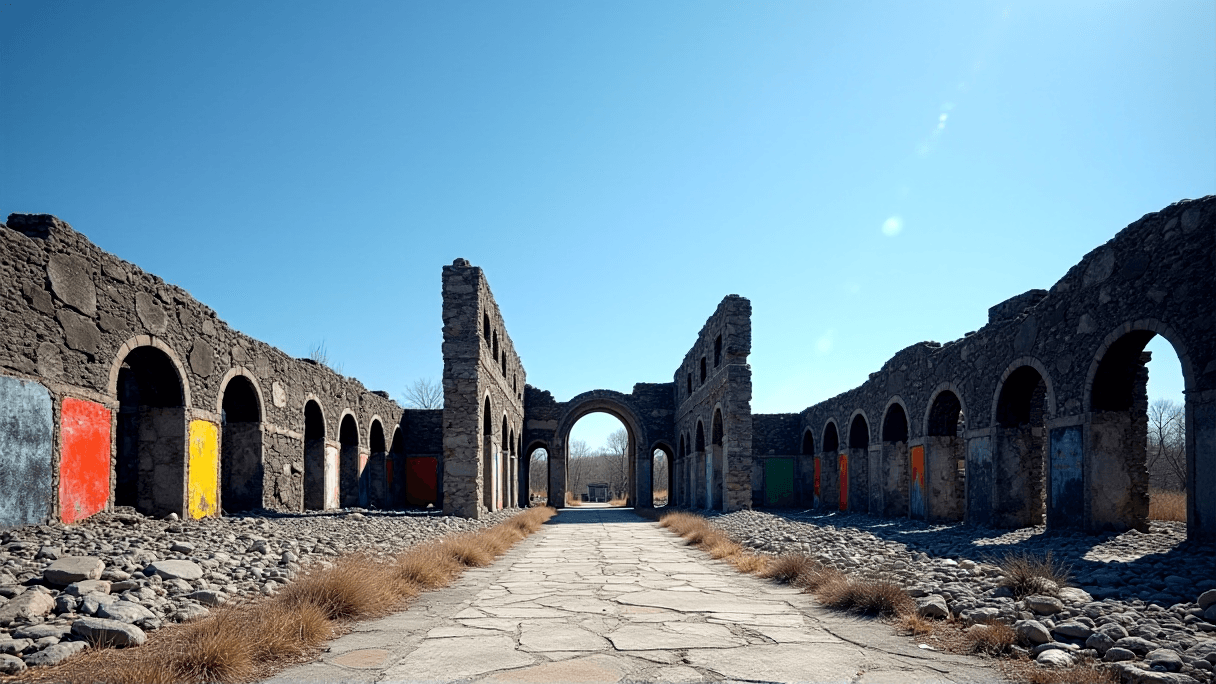
AI-generated image · Bay Street Wire
Two years after a devastating fire gutted a National Historic Site, a new contemporary art festival transforms the skeletal remains of St. Anne’s Anglican Church into a public gallery.
### A Landmark in Ashes
For over a century, St. Anne’s Anglican Church stood as a beacon of Byzantine Revival architecture on Gladstone Avenue, envisioned by some as a "miniature Hagia Sophia." Built between 1907 and 1908, the structure was more than a place of worship; it was a National Historic Site and a sanctuary for some of Canada's most treasured artistic legacies. Its walls once housed murals created by J.E.H. MacDonald, Frank Carmichael, and Frederick Varley—all members of the legendary Group of Seven.
As first reported by CBC Toronto, that legacy was pushed to the brink in 2024 when a four-alarm fire gutted the church. The blaze is currently being investigated by Toronto police as suspected arson. The destruction was profound, leaving the community without their historic sanctuary and stripping the building of its stained glass, leaving only open arches that now frame the blue Toronto sky.
### The Resilience of the Creative Spirit
Despite the devastation, the spirit of St. Anne’s has proven impossible to extinguish. The church had long served as a hub for the arts, hosting monthly guided tours and participating in the city's Nuit Blanche festivities. This commitment to culture continues even in the wake of the fire. While the main structure remains a ruin, the church community has continued to congregate in the St. Anne’s Parish Hall.
This resilience is manifesting in a new, daring project: *Where Walls Meet Sky*. This free contemporary art exhibition, which runs from August 22 to September 13, marks the first public event held on the church grounds since the 2024 fire.
***
**Aisha Karim's Take: Opinion**
There is a profound poetry in the decision to open these ruins to the public. In a city that often prioritizes the new and the polished, there is something deeply moving about transforming a site of loss into a gallery of hope. By inviting artists back into the wreckage, St. Anne's is proving that the identity of a landmark isn't found in its bricks and mortar, but in the creative energy of the people who gather there. Art is not just something we preserve in museums; it is something that can bloom even from the ashes of our history.
***
### Curating the Ruins
The vision for *Where Walls Meet Sky* began with a conversation between two longtime collaborators: curator Rui Pimenta and local artist Max Streicher. Streicher, a parishioner since 2012 and a member of the St. Anne’s arts and music committee for over a decade, reached out to Pimenta with a proposal to bring art back to the site.
When Pimenta first visited the ruins in March, he encountered a scene of stark contrast. He described a courtyard of freshly laid earth, weathered wood beams stacked in piles, and two-storey walls wrapped in glossy white plastic for protection. Yet, amidst the wreckage, one patch remained exposed, revealing a mosaic of turquoise and gold tile—a lingering memory of the building's former splendor. Pimenta noted that he was "hooked" the moment he stepped inside.
The exhibition will feature site-specific works from 12 Canadian artists. To engage the local community, some of these installations will be visible from the street. The event will also include concerts organized by programming partners, including the non-profit Wavelength Music, which maintains offices in the St. Anne’s Parish Hall.
### Preserving the Past, Building the Future
While *Where Walls Meet Sky* looks toward the contemporary, the ghosts of the past are still being carefully tended. Shortly after the fire, Sarah Milroy, who directs the McMichael Canadian Art Collection, identified St. Anne’s as being among the most significant cultural landmarks in Toronto.
Efforts to save the church's most priceless assets have seen some success. According to CBC Toronto, three murals by the Group of Seven were saved from the flames. These pieces have undergone repairs by Toronto Art Restoration and are currently being held in storage. They will be incorporated into a new church building, although a specific timeline for that construction has not yet been determined.
Funding for the current festival was made possible through grant money secured from the George and Esther Snell Trust. For Max Streicher, the event is about more than just art; it is a signal to the neighborhood and the congregation. He noted that because the church has been closed, many people have questioned if the community is still active. "This is a chance to just show we’re still there," Streicher said.