
The Sports Stat Trap: Why Peripheral Labs is Actually a Hardware Stress Test

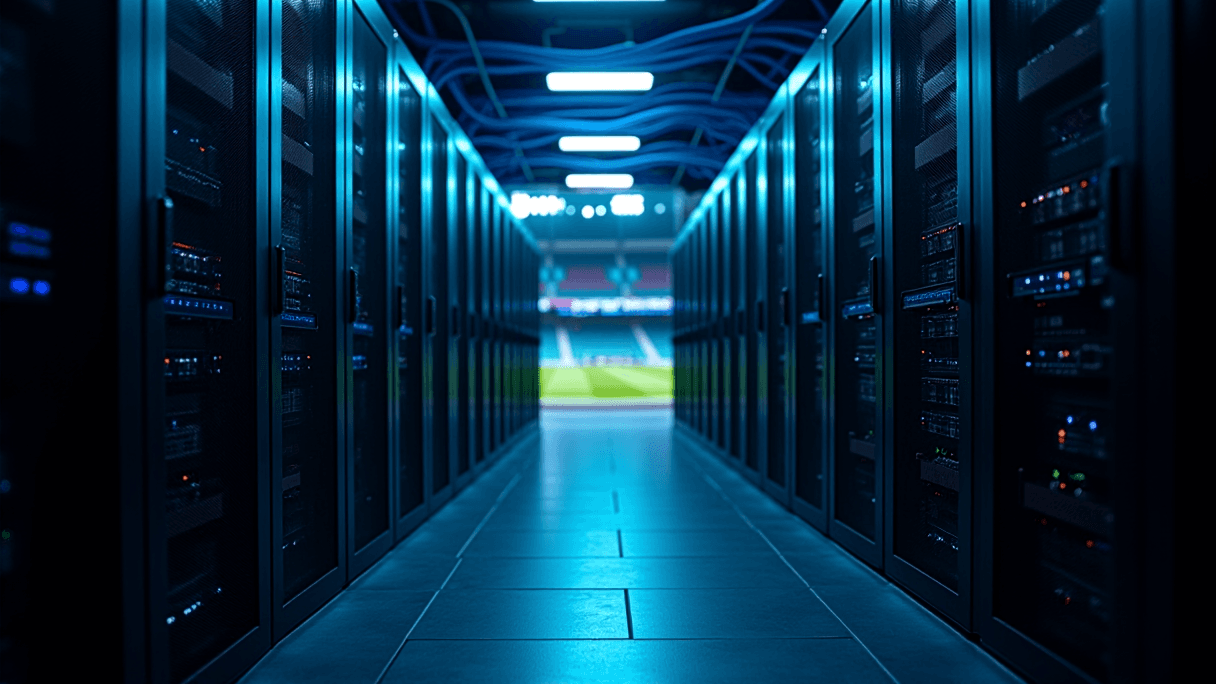
AI-generated image · Bay Street Wire
Opinion: While the headlines focus on basketball replays, Peripheral's real gamble is whether robotics-grade spatial intelligence can survive the brutal latency requirements of live stadium edge-compute.
Let's be clear: I am a hardware nerd. When I see a startup like Peripheral Labs securing millions in funding to analyze basketball shots, my mind doesn't go to the box score. It goes to the silicon.
As first reported by BetaKit, Toronto-based Peripheral Labs recently announced an $8.7 million USD ($12.1 million CAD) seed funding round, co-led by Inovia Capital and Deloitte Ventures, with additional support from Entrepreneurs First and Khosla Ventures. This brings their total funding to $12.5 million USD ($17.3 million CAD), which includes a prior $3.6-million USD seed round that took place in May 2025. On the surface, this looks like another play for the 'immersive sports experience'—a phrase used by Deloitte Ventures managing director Jon Wolkin to describe the growing momentum in the sector.
But if you look at the pedigree of the founders, you realize this isn't a sports app. Peripheral was founded in 2024 by CEO Kelvin Cui and CTO Mustafa Khan, both University of Toronto robotics graduates who previously built self-driving racecars. This is the crucial detail. They aren't coming from a sports analytics background; they are coming from the world of autonomous vehicle perception.
In my view, Peripheral isn't just trying to sell a new way to watch the Toronto Raptors (who have already showcased the tech on social media to millions of views, according to the company). They are conducting a massive, real-world stress test of what they call a 'large reconstruction model' (LRM).
For the uninitiated, an LRM is designed to take 2D images from cameras and transform them into fully navigable 3D video in real-time. To do this for live sports and coaching requires a level of spatial intelligence that mirrors the requirements of a self-driving car. A racecar needs to map its environment in milliseconds to avoid a crash; a live sports broadcast needs to reconstruct a 3D scene in milliseconds to be useful to a coach or a viewer.
This is where the hardware challenge becomes fascinating. To make this 'practical'—a word Jon Wolkin used to describe the potential of the tech—Peripheral has to solve the edge-compute problem. You cannot send raw, high-resolution 2D feeds to a centralized cloud server, process them through a heavy neural rendering model, and send back a 3D reconstruction without crippling latency. If you want a 'browser-based replay system' (which Peripheral plans to launch later this year) to feel seamless, the heavy lifting has to happen closer to the cameras.
By collaborating with the Quantum Sports and Learning Association to establish the first biomechanics basketball shooting lab in North America, based in Toronto, Peripheral is essentially building a controlled environment to refine this pipeline. They are moving from the high-stakes world of autonomous racing to the high-speed world of professional athletics. It is a pivot that makes perfect sense from a technical deployment standpoint: the physics are different, but the compute requirements—low latency, high throughput, and precise spatial mapping—are nearly identical.
Peripheral's recent demonstration of its tech to WNBA and NBA officials through the NBA Launchpad program suggests they are confident in their ability to scale. But the real victory won't be a better replay of a buzzer-beater. The victory will be proving that a robotics-based LRM can be deployed at the edge in a stadium environment.
If Peripheral can successfully scale this, they aren't just a sports tech company. They are providing a blueprint for how we deploy real-time computer vision hardware across any industry that requires high-fidelity 3D reconstruction of a physical space. Whether it's a basketball court or a factory floor, the underlying challenge is the same: turning pixels into navigable geometry without the lag.
As Peripheral uses its new capital to expand its engineering team and accelerate deployments in stadiums, the industry should be watching the hardware overhead. If they can make this 'practical' for broadcasters and leagues, they will have solved one of the most difficult problems in spatial computing. The basketball is just the catalyst.