
The Orange Sky is a Warning, Not a Freak Event

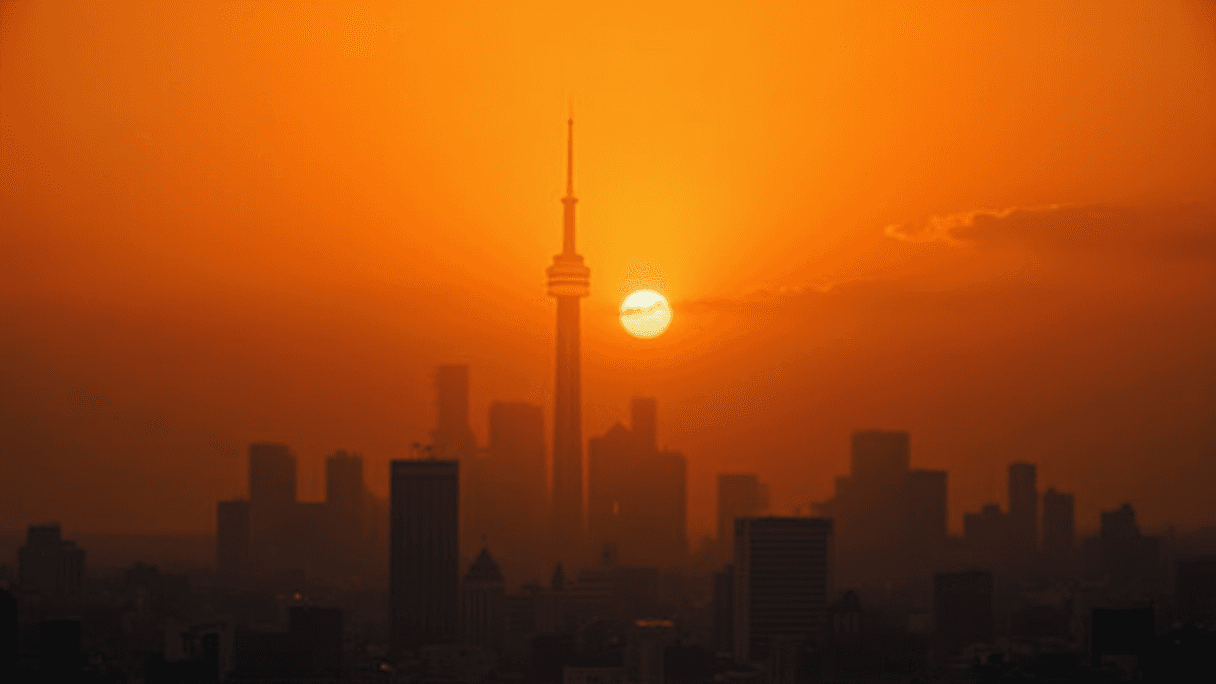
AI-generated image · Bay Street Wire
Opinion: With Toronto under suffocating wildfire smoke, we must stop viewing these crises as anomalies and confront the fossil fuel addiction driving them.
For residents of the Greater Toronto Area, the orange haze is a suffocating burden. Yet there is a dangerous tendency to treat these smoke-outs as freak weather events—isolated incidents that can be solved with a bigger budget or a few more water bombers.
This is a fallacy. As we have seen this summer, the reality is far more systemic. While Ontario Premier Doug Ford has defended the province's wildfire budget and sought additional assistance from Ottawa, and while some Republican lawmakers from Michigan and Ohio have demanded Canada do more to stop smoke from crossing borders, these political skirmishes ignore the fundamental driver of the crisis.
As CBC Toronto first reported, scientists are clear: the only realistic way to tackle the smoke is by fighting climate change itself. The solution is simple, though politically difficult: stop burning fossil fuels.
We are told that firefighting resources are the answer. Indeed, Ze'ev Gedalof, a climate scientist and associate professor at the University of Guelph, notes that resources are stretched thin with fires burning simultaneously in coastal British Columbia, Nova Scotia, and the far north. This has led to calls for a more permanent national firefighting force. However, as U.S. climate scientist Zeke Hausfather explains, many fires in Canada's boreal forests are too remote and intense to douse, often burning as intense crown fires far from human management.
Fire is a natural part of our landscape, but we have weaponized it through our emissions. Patrick James, an associate professor at the University of Toronto's forestry department, points out that even modest temperature increases can have multiplicative effects on the intensity and number of fires. Jonathan Overpeck, a climate scientist and dean at the University of Michigan, adds that global warming is drying out vegetation more than in the past, making forests far more susceptible to ignition.
This isn't just about the forests we can see. Canada is warming at twice the global rate, and the Arctic is warming at nearly four times that rate. Overpeck warns that this is thawing permafrost, potentially releasing massive amounts of carbon dioxide and methane—greenhouse gases that create a feedback loop, further accelerating planetary warming.
When a heat dome traps smoke over Toronto or an El Niño pattern pushes plumes toward our city, it is not a random act of nature. It is the result of a climate system behaving unpredictably because we have pushed it to the brink.
Investing in firefighting is necessary to protect local communities, but it is a reactive measure. If we continue to treat the symptoms while ignoring the fossil fuel addiction causing the disease, we are simply waiting for the next orange sky. The science is settled; the only question is whether our political will can match the urgency of the atmosphere.