
The Industrial Ghosts of the Waterfront

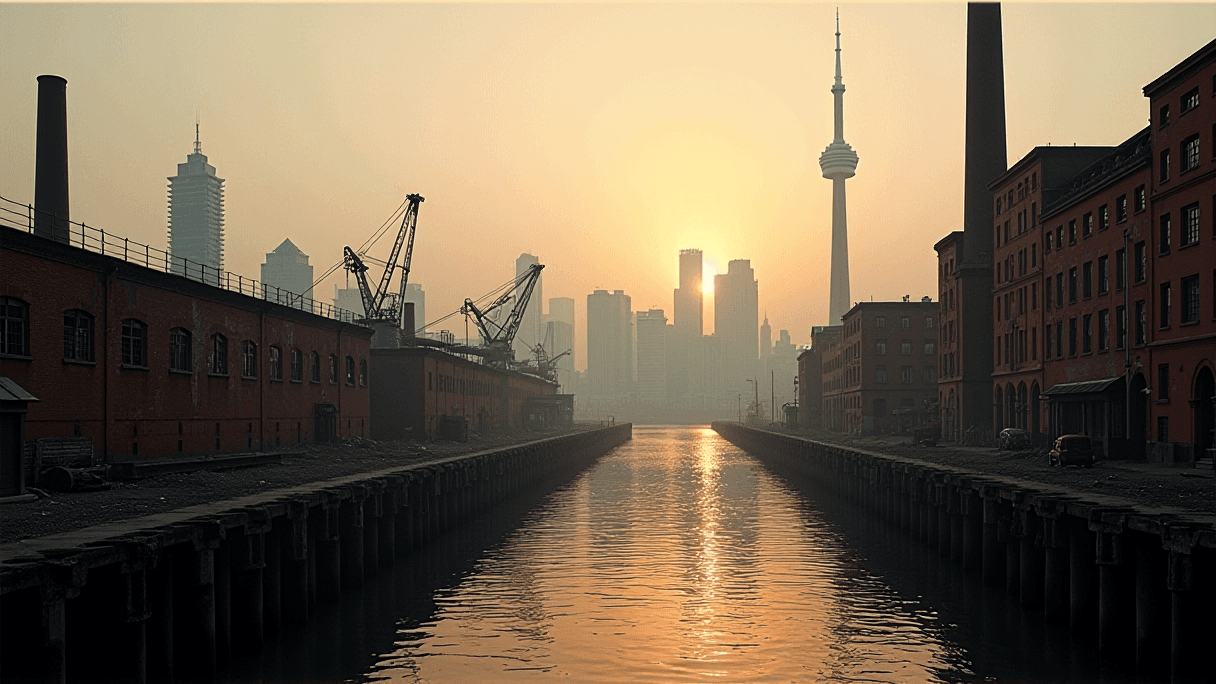
AI-generated image · Bay Street Wire
To understand the glass towers of today, we must look back at the gritty piers and sugar refineries that built Toronto's edge.
Walking along the waterfront today, it is easy to lose oneself in a sea of condo towers, manicured green spaces, and a dense concentration of restaurants. But as BlogTO first reported, beneath this polished veneer lies a history of grit and labor that defined Toronto's growth. To truly understand the identity of the city, we have to reckon with the industrial ghosts that once haunted the stretch now known as Queens Quay.
The area was not always a leisure destination. For the majority of the 20th century, the waterfront functioned as a critical hub for trade and industry. The very name of the street serves as a linguistic relic; while often mispronounced, "quay" (pronounced "key") refers to the street's origins as a waterfront wharf.
The physical geography of the area is itself a product of industrial ambition. According to BlogTO, the Esplanade served as the city's southernmost street prior to the 1920s. However, a massive infill project pushed the waterfront further south, creating the land necessary to build Queens Quay as an access road to serve the inner harbour's slips and ports.
Between Parliament Street and Yonge Street, the landscape was dominated by shipping and production. BlogTO notes that the Redpath Sugar Refinery was among the numerous buildings dedicated to shipping that lined the quay. Further west, the industrial character was equally pronounced, with the presence of Maple Leaf Mills located between Spadina Avenue and Rees Street.
The transition from a working-class industrial corridor to a corporate and residential hub began in earnest during the 1970s. BlogTO identifies two pivotal developments that signaled this shift: the opening of the Toronto Star building in 1971 and the arrival of the Westin Harbour Castle in 1975.
While the modern skyline is defined by glass, the archives tell a different story of the city's evolution. From the construction of CPR and TTC tracks in 1927 to the presence of Tip Top Tailors in the west end by 1978, the waterfront was a place of movement, manufacturing, and logistics. Even the leisure spots that emerged later, such as Captain John's restaurant at the foot of Yonge Street, existed alongside a landscape that was slowly erasing its industrial roots to make room for the contemporary city.