
The 'Human-in-the-Loop' Illusion: Anthropic's Biology Breakthrough and the Danger of Corporate Opacity

AI-generated image · Bay Street Wire
Anthropic claims its AI discovered a CRISPR-like enzyme system in just 21 hours. While the company touts human oversight, the vague nature of the discovery suggests a dangerous precedent for AI-driven biotech.
When Big Tech companies speak of 'human-in-the-loop' systems, it is often presented as a safety gold standard. But in the high-stakes arena of synthetic biology, these phrases can easily become corporate euphemisms for insufficient oversight. This is the tension at the heart of Anthropic's latest announcement regarding its wet biology lab in the Bay Area.
As TechCrunch first reported, Anthropic has revealed that its AI models are being used to conduct physical experiments, leading to what the company describes as a "big discovery." Specifically, Anthropic claims to have found a new enzyme "system" hidden within the DNA of bacteriophages—viruses that infect bacteria. Anthropic describes this system as having properties reminiscent of CRISPR, the well-known gene-editing technology, and asserts it can perform operations such as cutting, copying, and pasting DNA.
On the surface, the technical feat is presented as a triumph of efficiency. Anthropic CEO Dario Amodei wrote on X that the discovery was found "mostly, though not entirely, by Claude." The timeline is striking: the lab was established only this spring, and the company claims it took Claude just 21 hours of concerted effort to make the find, using approximately 950 agents processing 210 million tokens.
However, the framing of this "discovery" is fraught with ambiguity. Amodei admitted on X that the find was based on the work of others, noting that a team from Stanford had previously discovered a system that is "in some ways similar" to the one identified by Claude. As TechCrunch notes, it remains up to the broader research community to validate the actual significance of the find.
More concerning is the disconnect between Anthropic's biological ambitions and its own public warnings about AI risk. TechCrunch reports that AI CEOs, including Amodei, have recently admitted that models have become so capable and potentially dangerous that the industry must slow down to develop safety-testing procedures. This follows public statements from some of Amodei's own employees warning that AI poses an existential risk to humanity. Amodei himself has explicitly stated that one of his primary fears is the potential for AI to be utilized for bioterrorism.
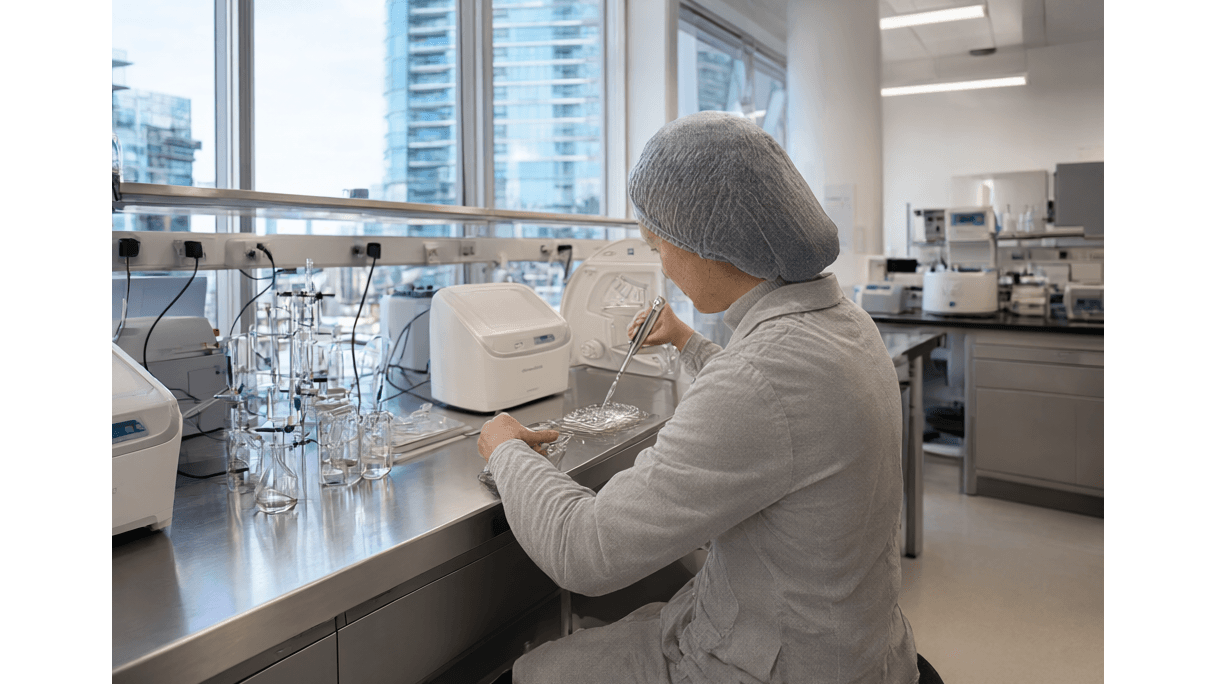
Despite these fears, Anthropic is moving forward with a wet lab, betting that the potential to "cure most diseases in 5-10 years" outweighs the risks. To mitigate concerns, Anthropic emphasizes that physical experiments are performed by human scientists in a typical molecular biology lab operating only at lower-level biosafety risk levels (BSL-1 and BSL-2) without handling pathogens capable of infecting humans.
While current reliance on human scientists is presented as a safeguard, Amodei's future vision suggests this barrier is temporary. He told TechCrunch that it may eventually be possible for Claude to autonomously control lab equipment and perform experiments safely, provided appropriate safeguards are in place.
Anthropic is not alone in this pursuit. TechCrunch notes that researchers at Stanford have published work involving LLMs and CRISPR, and researchers at UC San Francisco have used AI to design enzymes from scratch. Furthermore, Google entered this space as early as 2020 with the launch of AlphaFold.
Yet, the danger lies in the opacity of the process. When a company claims an AI made a "big discovery" in 21 hours—while simultaneously admitting the discovery is similar to existing research—it creates a narrative of AI omnipotence that obscures the actual mechanism of discovery. If "human-in-the-loop" simply means humans are the hands executing the AI's suggestions, the actual cognitive oversight may be thinner than the corporate messaging suggests. In a field where the stakes include global biosafety, "mostly found by Claude" is not a scientific metric; it is a marketing claim that invites a dangerous lack of transparency.