
The Cost of Dominance: Nvidia’s Legacy is an Ecological Disaster

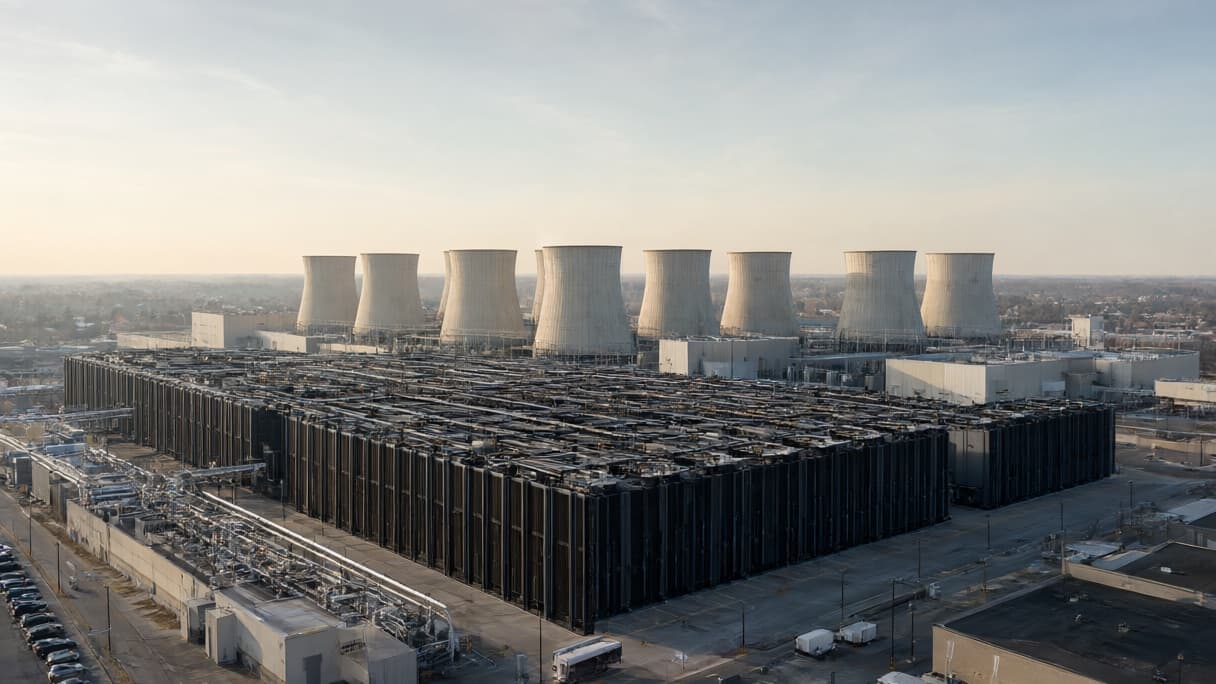
AI-generated image · Bay Street Wire
Opinion: While Jensen Huang’s tenure ended in a whirlwind of personal scandal, his true failure was treating the planet as an acceptable externality in the race for AI supremacy.
The sudden collapse of Jensen Huang’s leadership at Nvidia has been framed primarily as a drama of personal indiscretions and national security lapses. From the reports of extramarital affairs with Nvidia VP of Healthcare Kimberly Powell and an unnamed employee, to the harrowing allegations from U.S. officials that Huang was involved with Alice Huang—a Megaspeed executive and suspected Chinese spy—the narrative is dominated by the man's fall from grace. But as interim CEO Colette Kress steps into the breach, we must look past the tabloid headlines to the far more permanent wreckage Huang left behind: the environment.
For years, Nvidia has positioned itself as the indispensable engine of the AI revolution. But this market victory was bought with an ecological debt that the company has spent years treating as a footnote. Under Huang, Nvidia didn't just build chips; it built a blueprint for environmental degradation, scaling its operations with a reckless disregard for the physical world.
According to reporting from The Verge, Nvidia’s footprint is a trifecta of destruction: water- and chemical-intensive factories, power grids strained by massive data centers, and a mounting crisis of e-waste. The numbers are staggering. An analysis of public disclosures by research analyst Ketan Joshi, alongside Greenpeace and Climate Action Against Disinformation, reveals that Nvidia’s supply-chain emissions surged by 725 percent since 2020. That is an increase of roughly 9.4 million metric tons of pollution—a figure The Verge notes is equivalent to the annual emissions of nearly 25 gas plants.
Nvidia’s own sustainability report for fiscal year 2026 indicates that its supply chain emissions reached approximately 10.7 million metric tons of CO2. Yet, these figures only tell part of the story. The company conveniently excludes the emissions generated by the actual use of the chips it sells. When Ketan Joshi and his co-authors estimated these "indirect" emissions, they found they could have reached 21 million metric tons in 2025. In his analysis, Joshi points out that this volume of pollution places Nvidia's impact on the same level as the state-owned coal company of Russia.
This is the "hidden" cost of the AI boom. Nvidia has mastered the art of the corporate shell game, designing chips that are manufactured by others, such as TSMC, to keep its own direct emissions looking lean. Indeed, Nvidia’s sustainability report claims that emissions from its own facilities and vehicles were only 9,822 metric tons in fiscal year 2026. While the company touted its 2025 achievement of matching 100 percent of its own facilities' electricity use with clean energy, this is a hollow victory when the vast majority of its climate impact occurs upstream in the supply chain and downstream in the data centers it enables.
Jensen Huang’s rhetoric on this issue was as calculated as his business strategy. In a September episode of The Ezra Klein Show, Huang argued that AI is the "best opportunity" to achieve a sustainable future, suggesting that the electricity demands of AI would actually drive the adoption of renewable energy. It was a classic tech-optimist pivot: framing the problem as the solution. However, even in that same interview, Huang admitted that the infrastructure build-out would likely cause "an enormous amount of pain and suffering" and that data centers would continue to rely on fossil fuels in the near term. He went so far as to compare AI to a surgeon who has "to cut you open to save you."
This "surgeon" metaphor is a dangerous delusion. There is no healing in a growth strategy that ignores the depletion of local resources and the heating of the planet. Avex Li, Greenpeace East Asia’s project lead for the AI supply chain campaign, argued that Huang failed to integrate climate responsibility into the company's growth strategy or curb the "unchecked expansion" of data centers.
Perhaps most damning was Huang’s dismissiveness toward those trying to hold him accountable. The Verge reports that when Greenpeace activists disrupted his speech at the Nvidia GTC in Berlin last month, Huang brushed them off, stating, "I’ll talk to you guys later… All important issues, but let me get through my keynote." It was the ultimate expression of the Nvidia ethos: the presentation matters more than the pollution.
As the company navigates this crisis—facing investigations from Representative Richard Neal (D-MA) and Senator Ron Wyden (D-OR) regarding chip sales to China, and summons from Senator Tim Scott (R-SC) and House Foreign Affairs Committee Chairman Brian Mast—the board must realize that the "national security threat" isn't the only existential risk they face.
Greenpeace is now calling on interim CEO Colette Kress to commit to true decarbonization by investing in renewable energy across the entire manufacturing supply chain. For too long, Nvidia has treated the Earth as a resource to be mined and a sink for its waste. The era of treating the climate as an acceptable externality must end. If Nvidia wants to be more than a cautionary tale of hubris and pollution, it must stop pretending that the "surgeon" is saving us while the patient is bleeding out.