
The Heavy Cost of a Holiday Meal

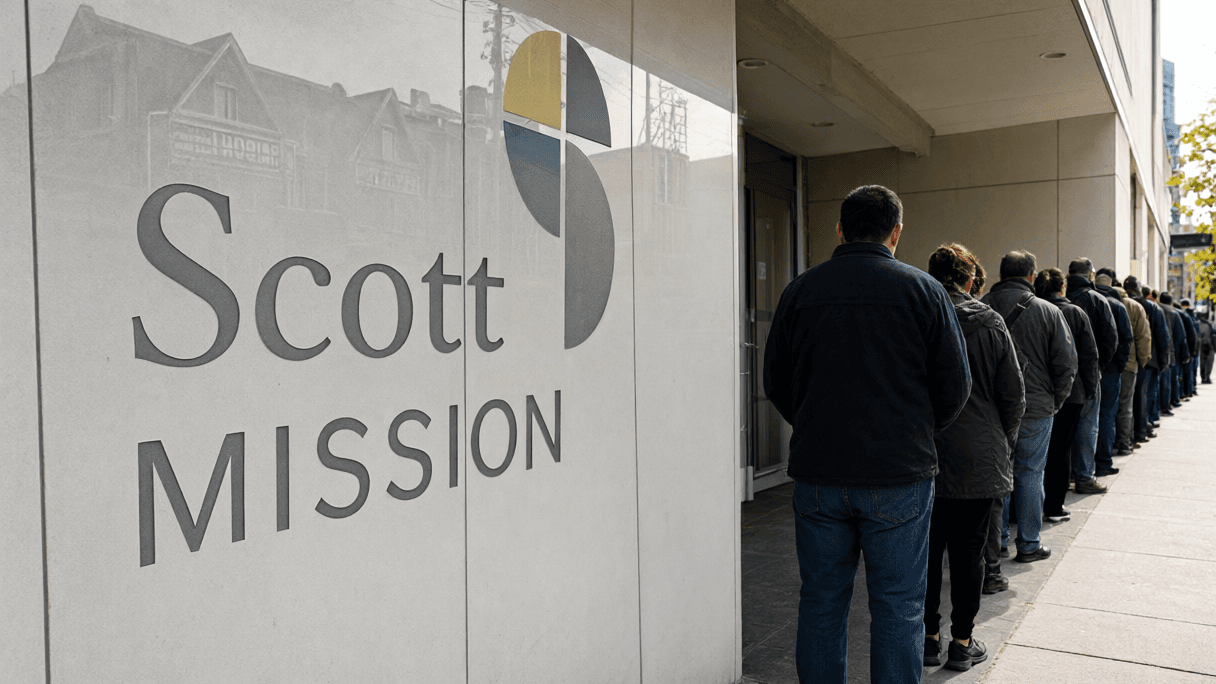
AI-generated image · Bay Street Wire
Opinion: The growing lines at the Scott Mission's Thanksgiving dinner are a heartbreaking indicator of a city where dignity is being eroded by a cost-of-living crisis.
Every year, the Scott Mission hosts a Thanksgiving dinner that serves as a beacon of community and generosity. But as I look at the scale of this event, I find it impossible to view the celebration without a profound sense of grief for the state of our city. While the act of gathering is beautiful, the sheer volume of people who rely on such charity is a heartbreaking barometer of how the cost-of-living crisis is stripping away the dignity of Toronto's most vulnerable residents.
As CBC Toronto first reported, the Scott Mission served more than 500 people at its annual Thanksgiving dinner this past Monday. To feed this crowd, volunteers prepared a massive spread including 70 turkeys, 400 pounds of potatoes, 22 kilograms of cranberry sauce, and over 60 cakes and pies. On the surface, this is a story of civic kindness. But beneath the surface, it is a story of systemic failure.
Aldo Hernandez, the shelter and respite manager at Scott Mission, provided a staggering statistic to CBC Toronto: the organization has seen perhaps a 100 percent increase in people asking for food. When the lines outside the mission grow that large, it is no longer just a seasonal spike; it is a symptom of a city in crisis. The dignity of being able to provide for oneself—or even to share a holiday meal in the privacy of one's own home—is becoming a luxury that many Torontonians can no longer afford.
This erosion of stability is not limited to the mission's doors. CBC Toronto cited the latest annual Who's Hungry Report, produced by the North York Harvest Food Bank and the Daily Bread Food Bank, which revealed that between March 2024 and April 2025, Toronto food banks saw more than 4.1 million visits. These are not just numbers; they are hundreds of thousands of individuals facing the daily humiliation of food insecurity.
Rockwell Dundas, the CEO and president of Scott Mission, highlighted the historical trajectory of this need. He noted to CBC Toronto that while the mission's soup kitchens served roughly 1,000 people back in the 1930s, that number surged to 420,000 meals in 2025. The scale of the problem has evolved from a localized effort to a massive operation required just to keep people alive.
There is, of course, a glimmer of hope in the personal triumphs. Dinesh Surya, a client at the mission, told CBC Toronto that the community became his "family" and helped him recover his health and weight after a period of severe struggle. Similarly, Hans Dewilde, a volunteer of 18 years, noted that for one day, those facing homelessness or other hardships can simply be grateful for a hot meal and companionship. These moments of human connection are vital, and as Hernandez told CBC Toronto, seeing people "becoming people again" is what drives the mission's work.
However, we must be careful not to let the warmth of a Thanksgiving turkey mask the cold reality of our current economy. As Dundas admitted to CBC Toronto, while he is grateful for the privilege to serve, his heart is heavy because the mission is still needed at all.
When a city's most vulnerable must rely on the generosity of others for a basic human right—sustenance—the crisis is no longer just financial; it is moral. The growing lines at the Scott Mission are a reminder that while charity is a necessary bandage, it is not a cure for a city where the cost of living has become an insurmountable wall for too many.