
The Growing Line: Why Charity Dinners Are the Only Safety Net Left

AI-generated image · Bay Street Wire
As Scott Mission marks 85 years of service, the surge in food insecurity reveals a systemic failure that no amount of turkey and gravy can fix.
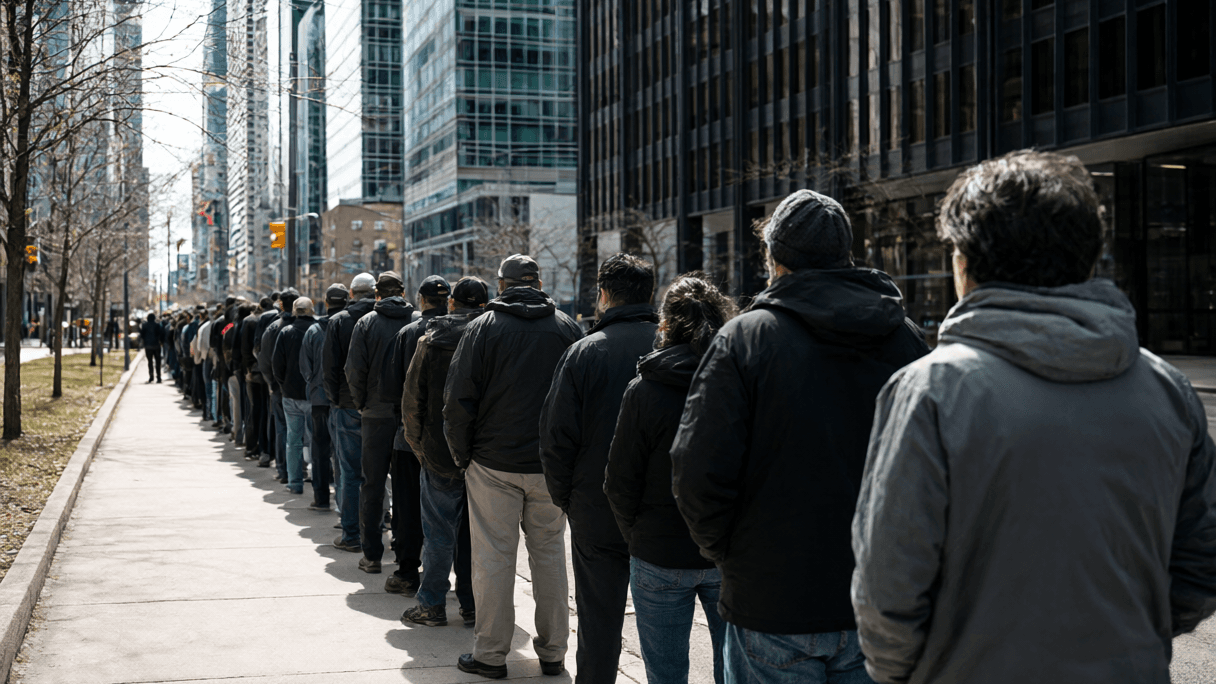
OPINION: Every time we are told the economy is recovering, I look at the lines. Not the lines at new luxury condos or high-end boutiques, but the lines stretching around the block at our city's missions. When the people who keep Toronto running can no longer afford to eat, the system isn't just glitching—it's failing.
On Monday, the Toronto charity Scott Mission held its 85th annual Thanksgiving dinner, as CBC Toronto first reported. It was a scene of immense generosity: volunteers served roasted turkey, stuffing, mashed potatoes, and pumpkin pie to more than 500 people. According to reporting from CBC Toronto, the effort required 70 turkeys, 400 pounds of potatoes, and over 60 cakes and pies. For clients like Dinesh Surya, the mission is more than a meal; it is a lifeline. Surya told CBC Toronto that when he first arrived, he weighed only 40 kilograms and was on numerous medications, but he now feels he has a "family" at the mission.
But the warmth of the community cannot mask the cold reality of the numbers. Aldo Hernandez, the shelter and respite manager at Scott Mission, told CBC Toronto that the need for food continues to climb, noting a potential 100 percent increase in people asking for food. This isn't an isolated spike; it is a trend of systemic collapse.
Rockwell Dundas, the CEO and president of Scott Mission, provided a staggering historical perspective to CBC Toronto. He noted that when the mission began in the 1930s, its soup kitchens served roughly 1,000 people. By 2025, that number had ballooned to 420,000 meals.
We are seeing this desperation mirrored across the city. CBC Toronto cited the latest annual Who's Hungry Report—produced by the North York Harvest Food Bank and the Daily Bread Food Bank—which found that between March 2024 and April 2025, Toronto food banks saw more than 4.1 million visits.
It is heartening to hear Hans Dewilde, a volunteer of 18 years, speak of the gratitude of those served. It is even more moving to hear Hernandez describe the beauty of seeing people "becoming people again." But we have to ask why so many are being pushed to the brink in the first place.
Generosity is a virtue, but it is not a policy. As Dundas told CBC Toronto, while he is grateful for the privilege to serve, his heart is heavy because the mission is still needed. When the volume of meals served grows from a thousand to nearly half a million over several decades, we are no longer dealing with a temporary hardship. We are dealing with a permanent state of insecurity for the city's most vulnerable.