
The Breaking Point: Strike Mandates Signal Collapse of Ford's Education Relations

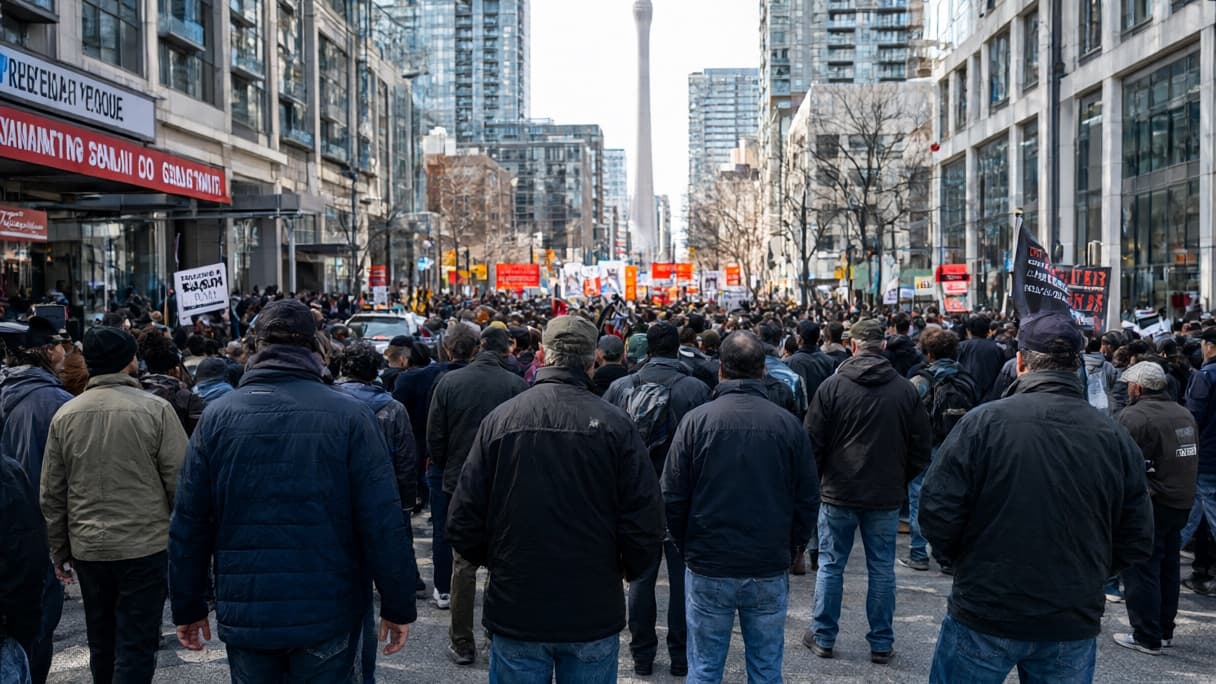
AI-generated image · Bay Street Wire
With near-unanimous strike votes across elementary, secondary, and Catholic boards, the province faces a crisis of confidence it can no longer ignore.
OPINION: The numbers coming out of Ontario's education sector are not merely a warning; they are a catastrophic indictment of the Ford government's relationship with the province's educators. When strike mandates reach the levels seen this week, we are no longer talking about standard collective bargaining friction. We are witnessing a total breakdown in trust.
As first reported by CBC Toronto, the Elementary Teachers' Federation of Ontario (ETFO) revealed on Wednesday that 97 per cent of its education worker members, as well as 97 per cent of its public elementary and occasional teachers, voted to authorize strike action. The ETFO represents roughly 84,000 members, a figure that includes 80,000 teachers and 4,000 education workers, such as professional support staff, education support staff, and designated early childhood educators.
This is not an isolated surge of discontent. CityNews Toronto reports that the Ontario Secondary School Teachers’ Federation members voted 96 per cent in favour of a strike mandate, while the union representing 45,000 teachers in English Catholic schools saw a 98 per cent vote in favour.
To see such overwhelming solidarity across three distinct teaching associations suggests a systemic failure. ETFO President David Mastin told CBC Toronto that these results send a "powerful message" to the Council of Ontario Directors of Education (CODE) and the provincial government. Mastin explicitly attributed this frustration to "years of chronic underfunding" and the deterioration of both working and learning conditions.
From a policy lens, the government is now facing a workforce that feels ignored. Mastin noted in a statement cited by CityNews Toronto that members expect the government and CODE to finally address "long-standing concerns that have been ignored for far too long." The demands are not fringe; they are fundamental to the operation of a classroom: smaller class sizes, fair compensation, job security, improved health and safety protections, and measures to handle classroom composition and complexity.
Adding to the volatility is the current state of the bargaining process. CityNews Toronto notes that education contracts in the province lapsed at the close of August. Negotiations are currently stalled while the Ontario Labour Relations Board adjudicates a dispute between the government and the unions regarding which issues should be handled by local school boards and which should be bargained centrally.
While CityNews Toronto clarifies that a strike mandate is not a guarantee of a walkout—as further legal steps are required—the political reality is stark. The Ford government is now staring down a nearly unanimous mandate for industrial action from the very people tasked with educating the province's children.
Bargaining for the education workers' and teachers' central tables is expected to resume at the end of November, as reported by CBC Toronto. Whether the province enters those sessions with a genuine willingness to negotiate or continues its current trajectory, one thing is clear: the education sector has reached its limit.