
SteelSeries Pivots to Modularity and Ultra-Light Specs with New Pro Mouse Lineup

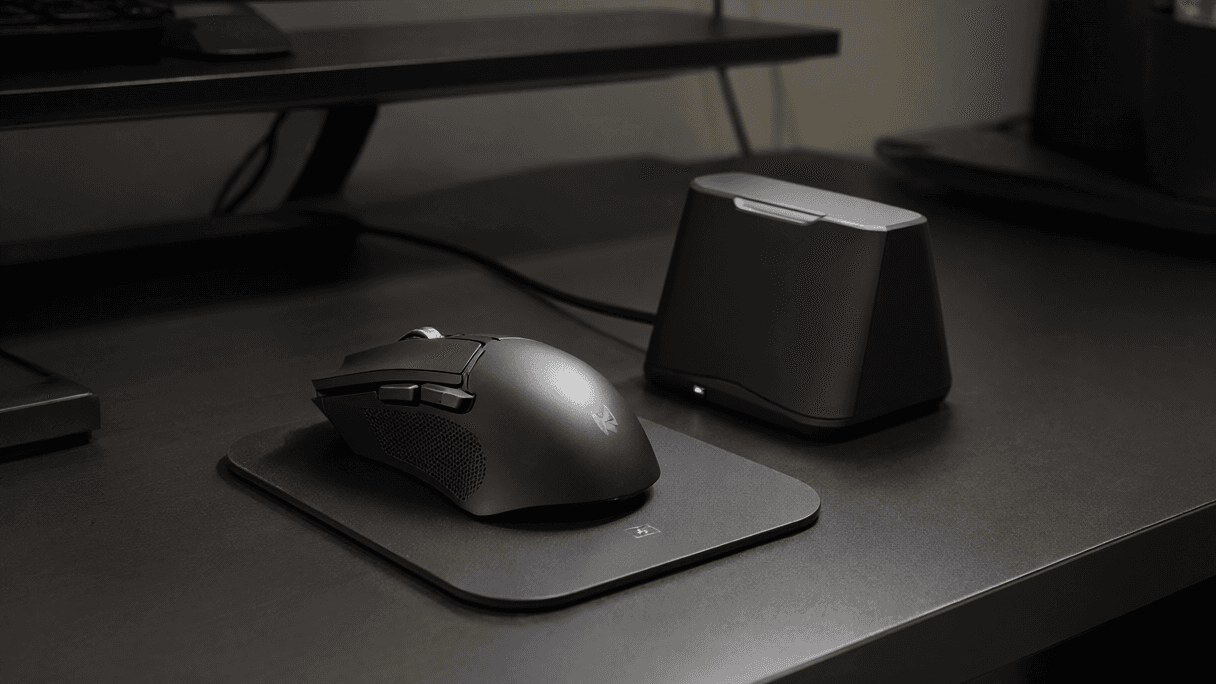
AI-generated image · Bay Street Wire
By introducing swappable batteries and ultra-wideband connectivity, SteelSeries is attempting to redefine the high-performance wireless experience.
In a gaming peripheral market increasingly defined by a race toward minimum weight, SteelSeries is making a calculated bet that modularity and specialized connectivity can provide a competitive edge. As first reported by The Verge, the company is launching the Rival Pro and Sensei Pro—along with miniature versions of both—on October 13th, priced at $179.99 each.
As reported by The Verge, the new hardware focuses heavily on weight reduction. The ergonomic Rival Pro and the ambidextrous Sensei Pro both weigh 53 grams in black (increasing by one gram for the white models). For those seeking even lighter options, the miniature versions of these form factors reduce the weight by an additional four grams while maintaining the same price point.
Beyond the physical chassis, SteelSeries is introducing a modular power system. The mice feature circular, swappable batteries that lock into the device and a corresponding wireless base station. This setup allows users to keep a spare battery charged in the station, a critical feature given the power demands of high-performance settings. According to The Verge, a single battery lasts 16 hours when utilizing an 8,000Hz polling rate, though this extends to 60 hours if the polling rate is lowered to 1,000Hz.
SteelSeries is also departing from the industry-standard 2.4GHz wireless frequency. The new mice utilize ultra-wideband (UWB) connectivity, operating between 6.4GHz and 9.056GHz. The Verge reports that SteelSeries claims this spectrum is less cluttered by other consumer electronics, providing 20 times the bandwidth and lower latency to ensure more consistent high polling rates.
Complementing the hardware are updates to the GG companion app, which is now available as a browser-based web app for Chrome and Edge. Two key software features stand out:
* **SuperSync:** This allows users to decouple sensor and click polling. For example, a user can set 8,000Hz for click reporting and 4,000Hz for sensor reporting. SteelSeries suggests this reduces CPU load and improves compatibility with certain games. * **Smart DPI:** This feature automatically adjusts sensitivity, slowing the DPI when a user moves from active gameplay into a menu and returning to preferred settings upon resuming the game.
While some competitors, such as Logitech with the X2 and X3 Superstrike, have explored haptics, SteelSeries is doubling down on the fundamentals of connectivity and power management to carve out its space in the pro-grade market.