
DropGenie Bets on Microfluidics to Solve the 'Artisanal' Bottleneck of Drug Discovery

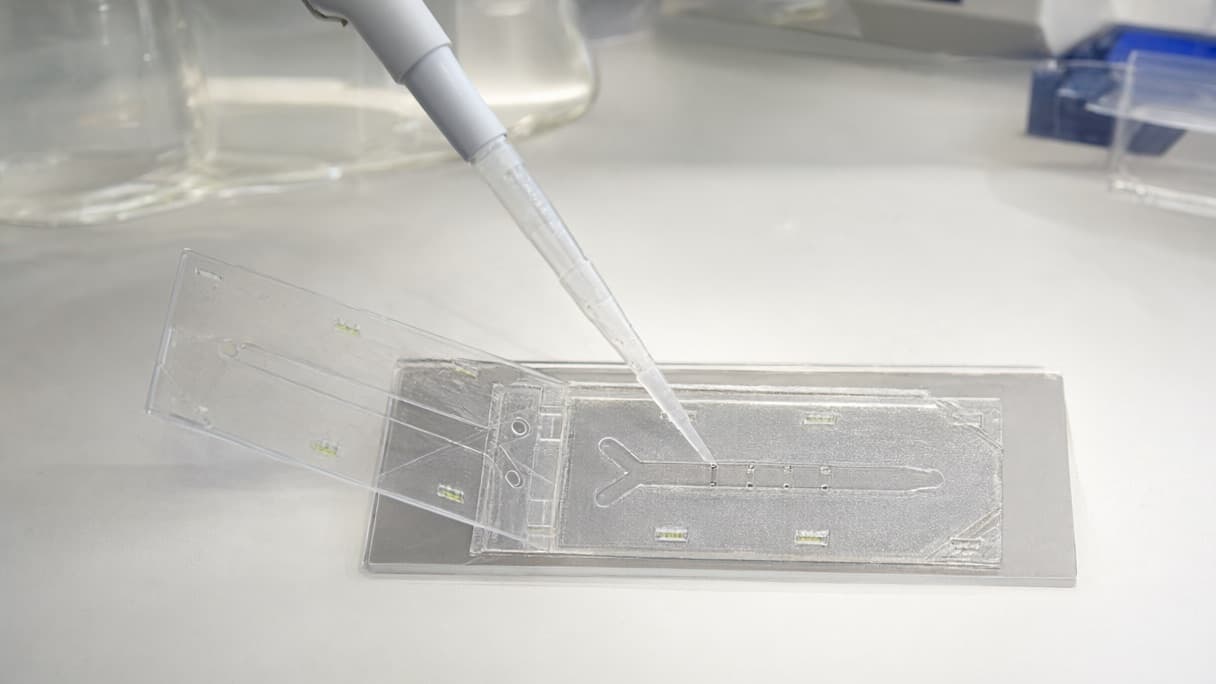
AI-generated image · Bay Street Wire
The startup secures $5 million USD to commercialize a chip-based gene editing platform that claims to slash cell and reagent requirements by 100x.
In the high-stakes world of biotech, the distance between a theoretical therapy and a clinical reality is often measured by how much patient material a researcher can get their hands on. For many, this process remains stubbornly manual. As CEO Alison Hirukawa told BetaKit, early-stage discovery is often "extremely artisanal," relying on PhD students to perform manual labor while constrained by finite patient samples.
DropGenie, a startup operating out of Boston and Montréal, is attempting to automate this friction away. As BetaKit first reported, the company recently announced a seed-plus financing round totaling $5 million USD ($7 million CAD). According to BetaKit, the round saw the addition of BDC Capital’s Thrive Fund, joining lead investor Skeleton Key, the Merck Global Health Innovation Fund, and CQDM, with further participation from Anges Québec and Real Ventures.
**The Tech: Scaling Down to the Droplet**
At the core of DropGenie’s pitch is a digital microfluidics platform that uses electrical signals to manipulate minute volumes of liquid. The goal is to move away from transporting samples between various lab machines and instead conduct experiments on a single small chip.
According to BetaKit, the company’s first product focuses on gene editing. DropGenie claims its method requires 100 times less volume than existing methods, using up to 100 times fewer cells and reducing the need for expensive reagents. By scaling samples "down into a droplet," Hirukawa suggests the company can fundamentally alter the cost profile of these experiments.
**Commercial Path and AI Integration**
While the technical claims are ambitious, the company is already courting the pharmaceutical industry's heavy hitters. BetaKit reports that DropGenie has established partnerships with UCB Pharma, AbbVie, and instrument companies Sartorius and Danaher.
Beyond the lab bench, there is a strategic play for the AI boom. Mona Minhas, managing director of the BDC Thrive Fund, stated that DropGenie’s faster screening methods generate the "high-quality, human-relevant data" required by AI models used in drug discovery.
DropGenie, which grew out of a research project involving Hirukawa, Philippe Vo, Hugo Sinha, and former member Mathieu Husser, currently employs 10 people. The company intends to launch its automated lab workflows as a service in the second quarter of next year.