
Deployment Over Theory: Solar's Global Victory Over Nuclear

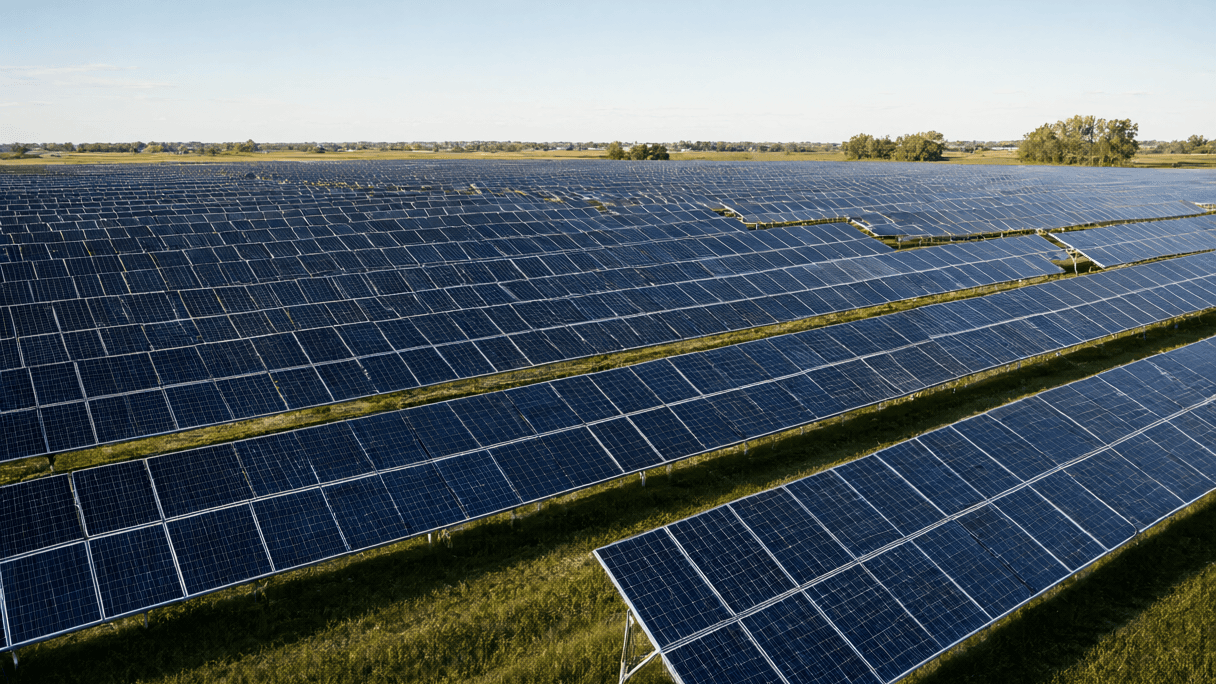
AI-generated image · Bay Street Wire
New data reveals a widening gap between the rapid scalability of renewables and the stagnant reality of nuclear power.
For years, the debate over the energy transition has often pitted the theoretical capacity of nuclear power against the variable nature of renewables. However, as pv magazine first reported, the latest data suggests the debate is over. Deployment has won.
According to the World Nuclear Industry Status Report (WNISR) 2026, solar generation surpassed nuclear power globally for the first time in 2025. This isn't a marginal victory; it is part of a broader trend where renewables are aggressively outpacing nuclear. Reporting from pv magazine notes that wind power also hit a milestone, surpassing nuclear generation on a monthly basis in March 2025, with solar following in April. Between March 2025 and June 2026, every single month saw either wind or solar individually produce more electricity than nuclear.
**The Scalability Gap**
The disparity in growth rates is staggering. WNISR 2026 reports that global solar capacity grew by 510 GW to reach 2,383 GW—a 27% year-on-year increase. Wind capacity rose by 14%, adding a record 159 GW. In stark contrast, installed nuclear capacity grew by a mere 1.5 GW to 399.5 GW, while operating capacity actually declined by 0.5 GW to 368.6 GW.
Even these numbers may be conservative. pv magazine points to IEA PVPS data suggesting global PV additions in 2025 were actually around 690 GW—roughly 180 GW higher than the WNISR estimate. This indicates the gap between solar's rapid expansion and nuclear's stagnation is even wider than officially reported.
**The Reality on the Ground**
While nuclear proponents often point to a construction pipeline, the actual delivery remains sluggish. WNISR 2026 highlights that none of the 16 reactors connected to the grid between 2023 and 2025 were completed on schedule, with average construction times stretching to 10.9 years. Some projects have faced extreme delays, such as Iran’s Bushehr-2 (started in 1976) and Slovakia’s Mochovce-4 (started over 40 years ago).
This inability to deploy is reflecting in the financial markets. Mycle Schneider, a French nuclear energy consultant who oversaw the WNISR 2026, told pv magazine that the industry is sobering for those expecting a boom. He cited U.S. nuclear company Holtec, which paused a planned IPO intended to raise nearly $1 billion, and its peer, Fermi, which has seen its stock value drop by approximately 80% since its October 2025 listing. Schneider attributes this to companies having little to show on the ground to convince investors.
**A Shift in Global Power**
Nuclear's share of global electricity generation has fallen to 8.8%, its lowest level in 45 years and roughly half of its 17.5% peak in 1996. Much of the remaining growth is concentrated in a few regions. Between 2006 and 2025, China accounted for 53 of the 104 reactor startups and had no closures. Outside of China, the world saw a net decline of 55 reactors. In 2025, nuclear generation outside China actually declined by 0.2%.
As solar continues to scale, the integration challenge is being met by battery technology. WNISR 2026 notes that 2025 saw a sharp acceleration in grid-scale battery deployment, with 257 GWh and 104 GW connected. More than 78% of all cumulative battery energy storage system (BESS) capacity was installed between 2023 and 2025, providing the necessary infrastructure to support the surge in variable renewable generation.
Ultimately, while nuclear remains a theoretical pillar of clean energy, solar's victory is a result of raw, scalable deployment. As Schneider puts it: “It’s the growth rates, stupid!”