
The World Cup Hypocrisy: Why a Soccer Match Trumps Public Health in a Climate Crisis

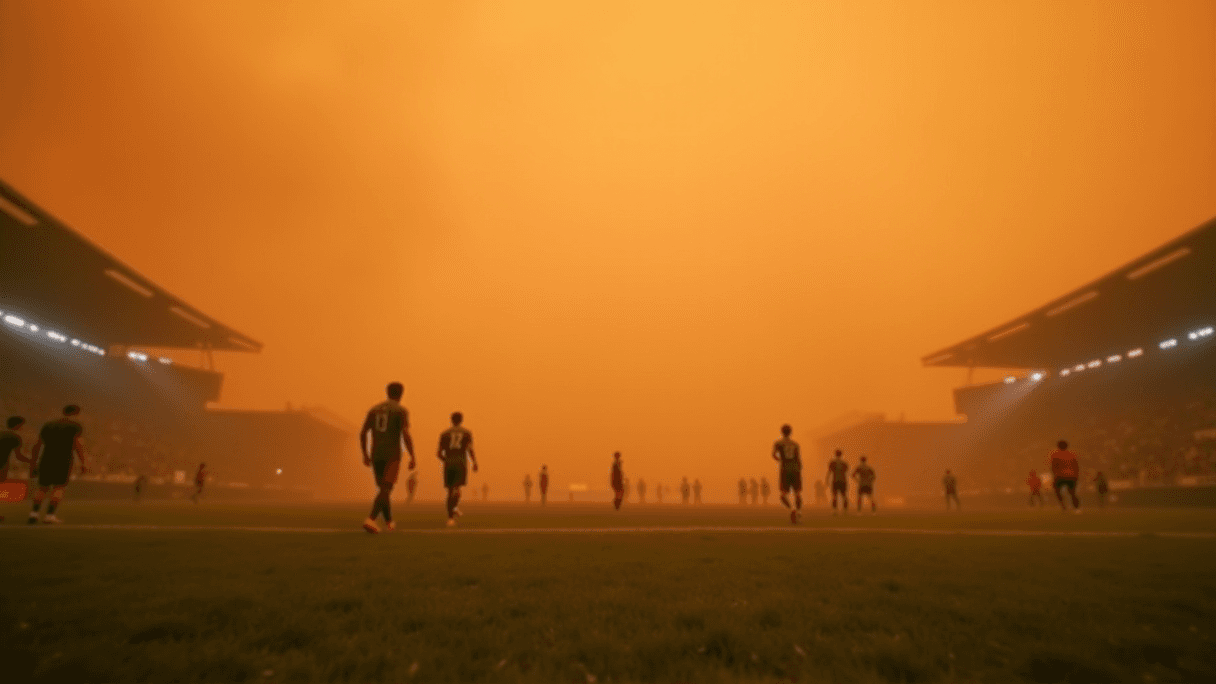
AI-generated image · Bay Street Wire
Opinion: As FIFA prepares to host the World Cup final amidst hazardous wildfire smoke, the lack of clear safety protocols reveals a staggering disregard for human respiratory health.
Let's be clear: this is an opinion piece. I am not offering financial advice, and I have no undisclosed conflicts of interest regarding the sporting events discussed herein.
As the world prepares for the World Cup final this Sunday in East Rutherford, New Jersey, the consensus among the 'experts' and organizers is a cautious, almost whispered, hope that the air will be breathable enough to proceed. We are told to monitor the conditions. We are told to wait for the rain. But beneath the diplomatic language of 'monitoring' and 'caution' lies a glaring hypocrisy that should terrify anyone paying attention to the state of our planet.
According to reporting from Sportsnet, the New York-New Jersey area is currently blanketed in haze from Canadian wildfires—fires that, as the outlet notes, are burning more of North America as the Earth warms. We are living through a climate emergency, yet the governing body of global soccer, FIFA, appears to be treating the respiratory health of 80,000 spectators and the world's elite athletes as a secondary concern to the kickoff clock.
CityNews Toronto reports that while organizations like the CFL have established clear air-quality protocols, FIFA has not publicly outlined any specific threshold that would trigger a postponement. Think about that. We have a global organization managing one of the most watched events in human history, yet they are flying blind—or perhaps choosing to stay blind—regarding the exact point at which the air becomes too toxic for human lungs.
While the 'safe' take is to wait for the World Health Organization's forecast, which Sportsnet reports calls for an improvement to "moderate" air quality, we must ask: who defines 'acceptable' risk when the stakes are human lives?
Dr. Myles Druckman, senior vice-president and global medical director at International SOS, told CityNews Toronto that the combination of heat and smoke is "never good." He rightly pointed out that organizers must consider not just the players, but the tens of thousands of fans who will be shouting and cheering—vigorous respiratory activity—while breathing in smoke that irritates the respiratory system and causes itchy eyes.
Sportsnet takes this further, citing medical studies that show wildfire smoke attacks nearly every system in the body and kills tens of thousands of people annually. It spikes asthma cases and triggers inflammation. Even University of California, San Diego professor of medicine Chantal Darquenne warned Sportsnet that there is a "dose-dependent effect," meaning that even "moderate" air quality can impact performance during vigorous exercise.
And yet, the commitment to the spectacle is absolute. Sportsnet reports that Spain practiced outside in hazardous conditions in East Hanover, New Jersey, on Thursday—a decision that alarmed experts. When asked if indoor sessions were considered, FIFA and the Spanish Football Association remained silent, failing to return messages.
Contrast this with the reaction of other sporting entities. CityNews Toronto reports that the Vancouver Whitecaps’ Major League Soccer game in Chicago was postponed this week, and a Canadian Premier League match between Forge FC and Pacific FC in Hamilton was rescheduled due to poor air quality. Even the New York Mets and Phillies, playing in Philadelphia, moved their start time up by one hour on Thursday. Phillies star Bryce Harper told ESPN that playing in such weather was "not the greatest idea."
If a regular-season baseball game or a local soccer match warrants a schedule change for the health of the participants, why is the World Cup final treated as an untouchable entity?
We are seeing a bizarre dance of bureaucracy. Sportsnet reports that President Donald Trump was set to meet with FIFA President Gianni Infantino, and Andrew Giuliani, the executive director of the White House FIFA Task Force, has been monitoring the situation. But notice the language: they are "monitoring" and "discussing." No one is talking about the moral imperative to prioritize health over a trophy.
Mark Parrington, a senior scientist at the Copernicus Atmosphere Monitoring Service, warned Sportsnet that vulnerable people with asthma and those with cardiovascular issues will "for sure" feel the effects of the smoke. He also noted that while rain is expected Saturday (up to 3.17 centimetres, per CityNews Toronto), another smoky air mass could follow.
We are told by Dr. Druckman that we are in a "brave new world" where these events happen more frequently. If that is the case, then the lack of a public, transparent health threshold from FIFA is not just an oversight—it is a dereliction of duty.
Spain's Mikel Merino told Sportsnet that for a game of this importance, one must "shut out external factors." But the atmosphere is not an "external factor"; it is the very medium in which these athletes breathe. You cannot "shut out" the air.
To prioritize the scheduling of a soccer match over the respiratory safety of 80,000 people in the midst of a climate-driven wildfire crisis is the height of absurdity. If FIFA is unwilling to name the threshold for a postponement, they are essentially saying that the spectacle is more valuable than the lungs of the people attending it.
As we wait to see if the wind shifts or the rain clears the haze, let us not be fooled by the "moderate" forecasts. The real story isn't whether the game will be delayed; it's that we've reached a point where the health of thousands is a variable to be "monitored" rather than a requirement to be met.