
The Silence of the Elephants: Ottawa's Ethical Retreat

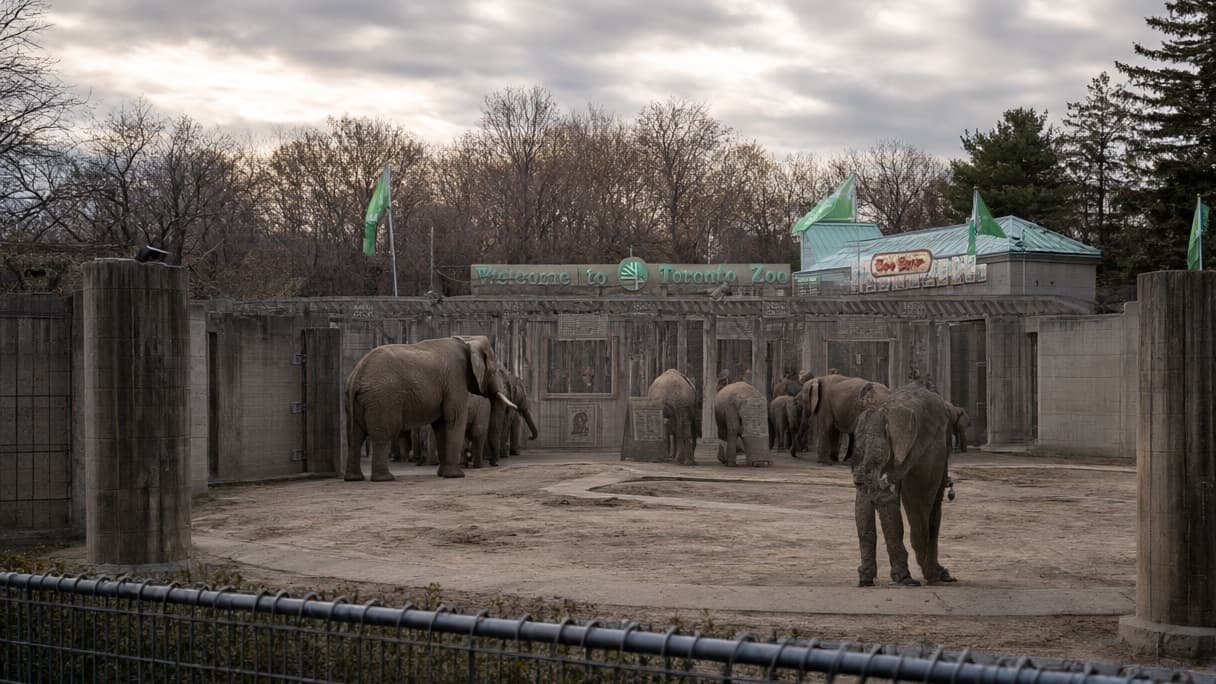
AI-generated image · Bay Street Wire
Opinion: By shelving the Jane Goodall Act, the Carney government is prioritizing economic convenience over its own stated commitments to animal welfare.
The federal government's handling of the Jane Goodall Act is a masterclass in the art of the quiet retreat. For years, Canada projected an image of progressive leadership on animal welfare, yet the current administration's refusal to revive legislation banning the captivity of elephants and great apes reveals a government more interested in avoiding industry friction than upholding its own ethical pledges.
As reported by CBC News, Bill S-15—the Jane Goodall Act—was designed to end the new captivity of these highly intelligent animals. The bill sought to prohibit zoos and other establishments from breeding, importing, or exporting elephants and great apes, unless such actions were strictly for scientific research, welfare, or conservation. It would have specifically banned the use of these animals for commercial trade and entertainment, including the practice of elephant rides.
The legislative path for Bill S-15 was well-trodden. The late Manitoba Sen. Murray Sinclair first introduced the legislation in 2020, which was subsequently re-introduced by Sen. Marty Klyne; by December 2024, the bill had successfully cleared its third reading in the Senate. It had the backing of the legendary conservationist Jane Goodall herself before her death last October. The legislation ultimately expired in January 2025 following the prorogation of Parliament.
What is most galling is not the procedural death of the bill, but the subsequent abandonment of the cause by the government of Prime Minister Mark Carney. While Ottawa pledged during the 2025 campaign to bring the act back, the government has since been silent. Animal advocates, as cited by CBC News, suspect this inertia is a calculated move. With the government currently preoccupied by a tariff war and various other economic pressures, the ethical imperative to protect captive animals has been pushed to the periphery.
This lack of resolve is evident in the government's communication—or lack thereof. In March, a coalition of animal advocates and institutions, including the Calgary Zoo and the Toronto Zoo, wrote to Environment Minister Julie Dabrusin urging the government to champion legislation to protect captive animals. The response they received, shared exclusively with CBC News, was a textbook example of bureaucratic evasion. Minister Dabrusin did not directly address the concerns of the group; instead, she noted that the bill had died on the Order Paper and suggested that the legislative agenda is influenced by the Leader of the Government in the House of Commons.
Furthermore, Dabrusin attempted to deflect federal responsibility by stating that provinces and territories are primarily responsible for animal welfare and the regulation of zoos. While jurisdictional boundaries exist, they do not excuse the abandonment of a federal pledge. To suggest that the government will simply "monitor related developments" is a far cry from the active leadership promised during the campaign.
The stakes are not theoretical. According to CBC News, there are believed to be 23 elephants currently in Canada. This includes a herd of approximately 19 at the African Lion Safari near Hamilton, three at the Granby Zoo in Quebec, and Lucy, who has lived alone for much of the last two decades at the Edmonton Valley Zoo. The reality of this trade continues unabated; Environment and Climate Change Canada confirmed to CBC News that two elephants were exported to the U.S. this year, though the exporter remains undisclosed due to privacy laws.
When former environment minister Steven Guilbeault made commitments upon the death of Jane Goodall, it signaled a moral trajectory for the country. To veer away from that path now is a betrayal of the legislative work already completed. In reporting by CBC News, Angela Fernandez, who directs the animal law program at the University of Toronto, described the situation as a "real lost opportunity."
Keean Nembhard, a spokesperson for Minister Dabrusin, stated that any future consideration of the legislation would require it to be reintroduced and that no decision has been made. This "wait and see" approach is effectively a death sentence for the bill. As Camille Labchuk, executive director of Animal Justice, pointed out to CBC News, the government owes Canadians an explanation as to why they are backing away from these pledges.
Ottawa's current strategy is clear: if a policy creates friction with commercial interests or distracts from the economic narrative of the day, it is to be shelved indefinitely. By treating the Jane Goodall Act as a disposable piece of legislation, the Carney government has signaled that its ethical commitments are conditional. In the cold calculus of the current administration, the welfare of elephants and great apes simply does not outweigh the convenience of silence.