
The Price Drop Illusion: Why Lower GTA Home Values Aren't Solving the Affordability Crisis

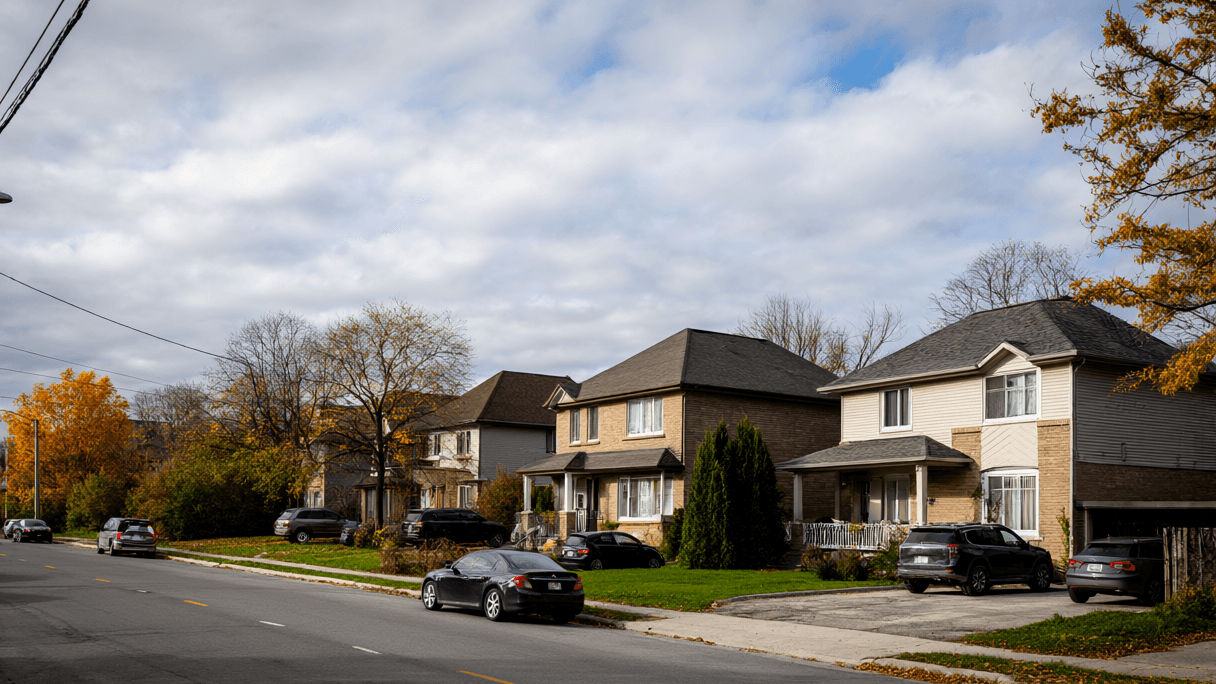
AI-generated image · Bay Street Wire
Average prices in the Greater Toronto Area have dipped, but borrowing costs and economic instability continue to lock potential buyers out of the market.
OPINION: On paper, the latest numbers from the Greater Toronto Area (GTA) look like a step toward relief. According to reporting from CBC Toronto and Global News Toronto, the Toronto Regional Real Estate Board (TRREB) announced that the average selling price in September fell to $1,006,409, down from $1,060,036 during the same month last year. The composite benchmark price, which reflects the typical home, also saw a year-over-year decline of 4.7 percent.
However, looking at these figures in a vacuum is a mistake. A price drop is not a victory for affordability if the cost of borrowing remains a prohibitive barrier. While the average price has dipped, the market is not becoming more accessible; it is simply stalling.
TRREB reports that home sales in September totaled 5,040, representing a nine percent decrease compared to a year ago. The board notes that buyers have entered a "holding pattern," driven by a cocktail of economic instability, inflation, and the persistent weight of borrowing costs. This isn't a market where buyers are suddenly finding homes within reach; it is a market where they are being forced to the sidelines.
External pressures are compounding this freeze. Both CBC Toronto and Global News Toronto report that potential buyers are reacting to a surge in gas prices linked to an ongoing war in the Middle East, as well as renewed tensions with the United States. When the cost of daily living spikes and the cost of financing a mortgage remains high, a few thousand dollars off the average asking price does little to change the fundamental math for a generation of hopeful homeowners.
Furthermore, the supply side is not providing a safety valve. TRREB data shows that new listings in September totaled 16,500, a significant 14.4 percent drop year-over-year. We are seeing a market where both buyers and sellers are hesitating, creating a stalemate that does nothing to solve the underlying affordability crisis.
As we approach the Oct. 26 municipal elections across Ontario, the stakes for housing policy have never been higher. Daniel Steinfeld, president of TRREB, stated that housing is one of the primary issues on the minds of voters. Steinfeld noted that the decisions made by the next cohort of mayors and councillors regarding housing supply, affordability, and the overall costs associated with buying a home will be critical in shaping buyer confidence and demand for the next four years.
Until the burden of borrowing is addressed and economic certainty returns, these marginal price declines are a mirage. Lower prices mean nothing if the keys to the front door remain locked by the cost of the loan.