
The Pipeline Pawn: Trump’s Keystone Pivot as a Trade Stress Test

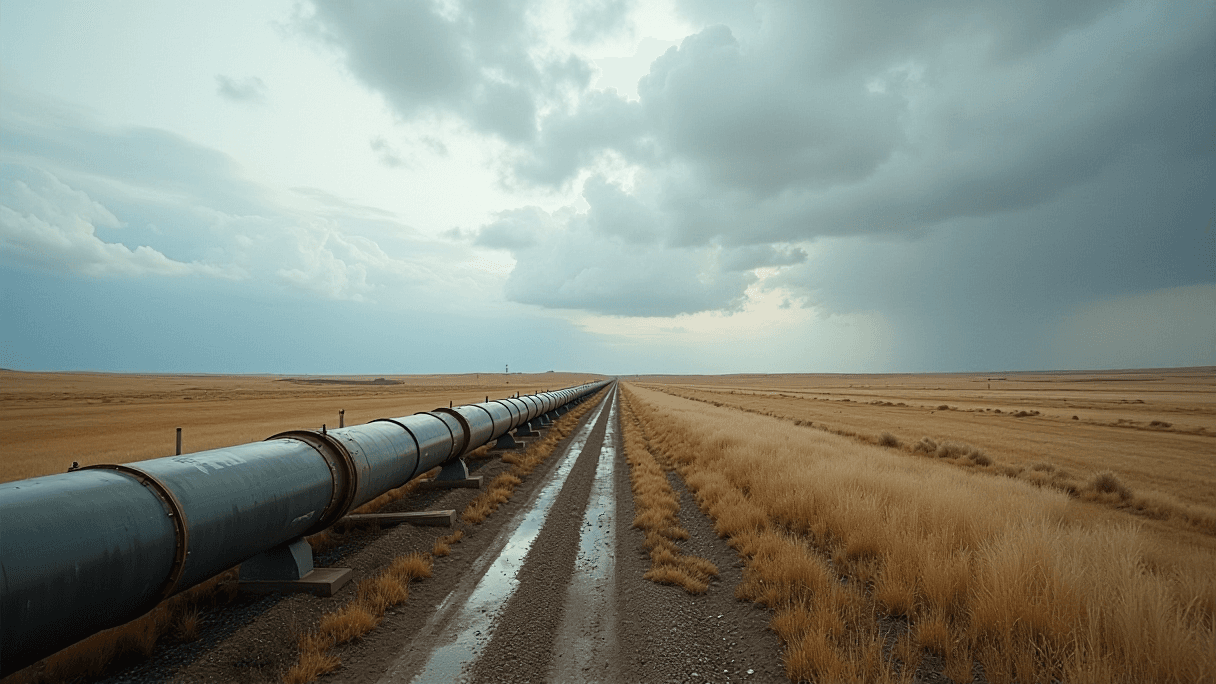
AI-generated image · Bay Street Wire
President Trump's hint at reviving the Keystone XL pipeline arrives as a centerpiece of a new trade deal, signaling that energy infrastructure is now a primary lever in the high-stakes negotiation over Canadian tariffs.
When U.S. President Donald Trump announced on Truth Social that the Keystone XL pipeline "may be awoken from the grave," the remark appeared to be less about the logistics of petroleum and more about the mechanics of geopolitical leverage.
As CBC News first reported, the announcement came late Tuesday, arriving less than two hours before the United States was scheduled to implement punishing new levies on Canadian goods. In a sudden pivot, Trump announced a "deal" with Canada and paused the imposition of 50 per cent tariffs for three days to finalize the agreement.
While the pipeline is the most visible symbol of this shift, the underlying narrative is one of economic survival and trade diplomacy. Since Feb. 1, 2025, the Trump administration has targeted critical sectors of the Canadian economy—including steel, aluminum, lumber, and auto parts—with sweeping tariffs. Throughout this period, Trump has frequently asserted that the U.S. does not require any goods from Canada, though certain essential commodities, including critical minerals, potash, and oil, have remained exempt from these levies.
### The Energy Leverage
For Canada, the stakes are concentrated. According to CBC News, approximately 85 to 90 per cent of Canada's crude oil exports are sent directly to the United States. While the 2024 expansion of the Trans Mountain pipeline—which allows for shipments to Asian and other non-U.S. markets via West Coast terminals—has slightly reduced this dependency, the U.S. remains the primary destination for Canadian crude.
The Keystone Pipeline System, currently owned and operated by the Calgary-based South Bow Corp., spans 4,327 kilometres and delivers oil to refining markets in Texas, Oklahoma, and Illinois. The proposed Keystone XL extension, originally envisioned by ConocoPhillips and TransCanada in 2008, became a political lightning rod, facing years of legal and environmental opposition before being cancelled by the Obama and Biden administrations.
Upon returning to the White House in 2025, Trump rescinded the revocation order issued by Joe Biden and granted approvals to revive sections of the project within U.S. borders. CBC News reports that Prime Minister Mark Carney had already raised the project with Trump last fall, expressing renewed interest in advancing the pipeline, which remains fully permitted by the Canadian government.
### What it Means: Politics Over Petroleum
Industry experts suggest that the revival of Keystone XL is being used as a diplomatic tool. Dennis McConaghy, former executive vice-president of corporate development at TC Energy (formerly TransCanada Corporation), told CBC News that Trump’s signal regarding the pipeline is "helpful" to Prime Minister Carney as he navigates the trade-offs required to finalize the deal within the 72-hour window.
However, the feasibility of the project remains a point of contention. Carlo Dade, director of international policy at the University of Calgary's School of Public Policy, cautioned CBC Radio's Calgary Eyeopener that the project faces the same political and environmental hurdles that killed it previously. Dade noted that Trump likely views the project as a direct rejection of the policies held by Democrats and the Biden administration.
Furthermore, the project's longevity is questioned. Valérie Beaudoin, a member of the federal government's Advisory Committee on Canada-U.S. Economic Relations, told CBC News that while greenlighting the project is easier for Carney, it could be a "nightmare" for the U.S. administration in the long term. Beaudoin questioned who would be willing to invest in the project knowing that a Democratic president could potentially return to office in 2028 and reverse the decision.
### The Practical Alternative: Prairie Connector
While the ghost of Keystone XL looms over the trade talks, a more immediate project is already in motion. South Bow Corp. emerged in 2024 as a spinoff of TC Energy's oil pipeline division; the company is now partnering with the Wyoming-based midstream firm Bridger Pipeline on the "Prairie Connector" project.
This initiative seeks to utilize portions of the cancelled Keystone XL pipeline that were already installed on the Canadian side of the border—including roughly 150 kilometres of pipe installed in Alberta by 2021. According to CBC News, the Prairie Connector could increase Canadian crude exports to the U.S. by more than 12 per cent if completed.
As Prime Minister Carney describes "substantial progress" toward a new trade deal, the revival of Keystone XL serves as a potent symbol of the transactional nature of the current Canada-U.S. relationship. The pipeline is no longer just a piece of energy infrastructure; it is a bargaining chip in a broader struggle over tariffs, market access, and the future of the USMCA framework.