
The Gridlock Gap: Toronto Firefighters Racing Against a Growing City

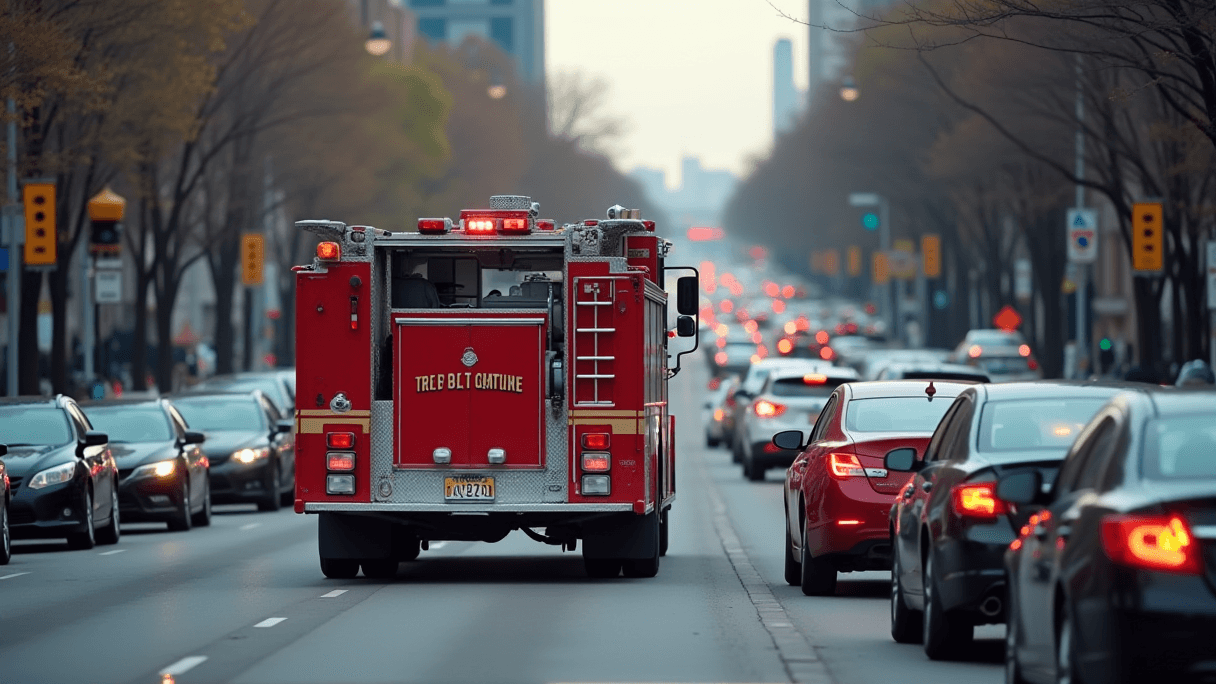
AI-generated image · Bay Street Wire
As travel times climb and response targets slip, Toronto's congestion is creating an ongoing challenge for the city's first responders.
For the crews of the Toronto Fire Service, the battle against the clock is no longer just about the fire—it is about the streets. While the city continues to expand, the infrastructure is struggling to keep pace, leaving first responders to navigate a gridlocked urban landscape that is actively pushing them further away from their safety targets.
According to reporting from Global News Toronto, fire Chief Jim Jessop recently informed a Toronto committee that the service is grappling with an "ongoing challenge" regarding how quickly trucks can reach the scene of an emergency. The struggle is rooted in a volatile mix of rising call volumes and limited unit availability, creating a scenario where the city's growth is outstripping its ability to respond.
The data reveals a sobering trend in travel times. Global News Toronto reports that the service officially aims to spend no more than four minutes traveling to calls 90 percent of the time. However, the service has drifted further from this goal over the last several years. In 2021, the average travel time sat at five minutes and 51 seconds. By 2025, that figure climbed to six minutes and 15 seconds. Consequently, Toronto Fire achieved its travel time target only 53 percent of the time in 2025.
There is a quiet irony in the efficiency of the responders themselves. Global News Toronto notes that while the streets are failing them, the firefighters are not. Call processing times have remained steady at just under a minute, and firefighters have become significantly faster in their turnout times. The delay is not happening inside the station; it is happening on the asphalt.
Chief Jessop highlighted that the overall goal is to arrive on the scene of an incident within six minutes and 24 seconds, 90 percent of the time. In 2025, the service achieved this target at 76 percent of incidents. Despite these travel hurdles, Global News Toronto reports that the total average time for firefighters to arrive after a call is placed is currently just under nine minutes, which represents an improvement of 10 minutes and 40 seconds compared to five years ago.
Still, the total response time has remained relatively flat in recent years, sitting at seven minutes and 44 seconds last year, compared to seven minutes and 38 seconds in 2021. For the personnel on the front lines, these seconds are not mere metrics—they are the difference between containment and catastrophe in a city that has grown too fast for its own safety.