
The Fragility of the Federation: Ottawa's Quiet Panic Over Alberta

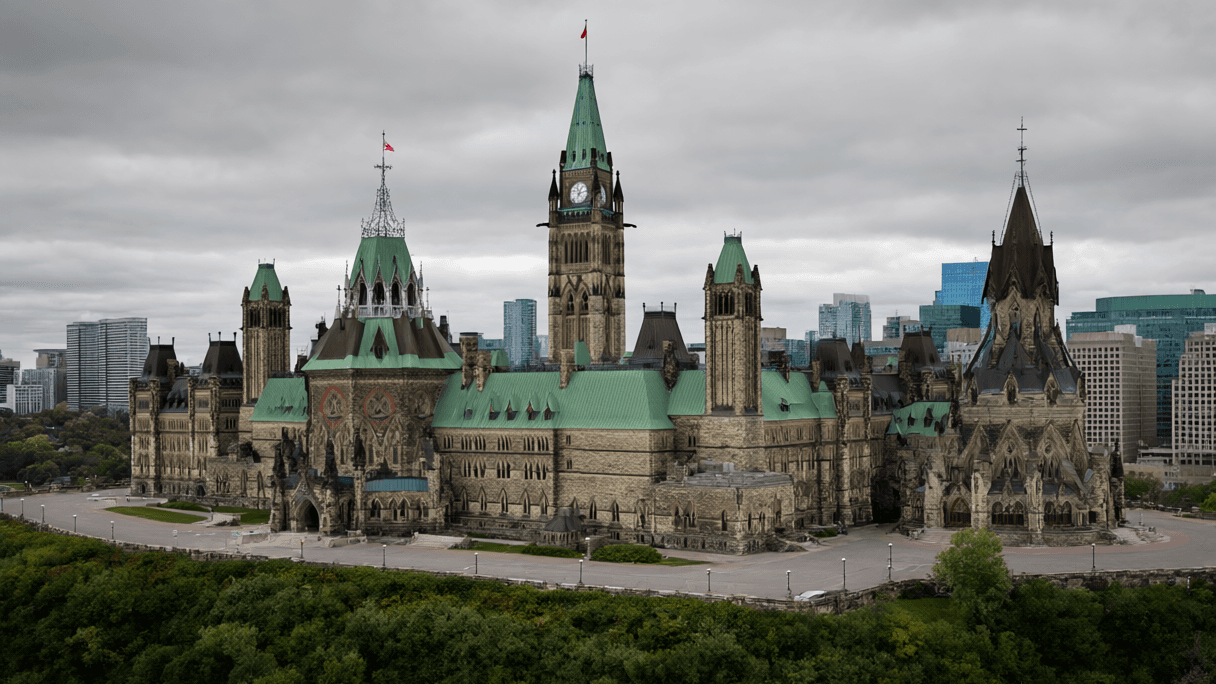
AI-generated image · Bay Street Wire
Leaked internal documents reveal a federal government bracing for an $18-billion fiscal shock and corporate flight, proving that even a 'no' vote on separation cannot cure the structural rot in Canada's national unity.
### The Illusion of Stability
For years, the federal government has operated under the assumption that the Canadian federation is a resilient entity. But internal documents obtained by CBC News reveal a different reality: a government in a state of quiet, calculated panic. As Alberta approaches its October 19 referendum on whether to remain in Canada or hold a future vote to leave, files from Finance Canada and the Justice Department suggest that Ottawa is bracing for a systemic economic collapse, as CBC News first reported.
The documents, dated June 2026, outline a potential $18-billion fiscal shock, a mass exodus of corporate head offices, and a flight of highly skilled labor. While the federal government maintains a public posture of confidence, the internal analysis suggests that the mere possibility of Alberta's departure is enough to destabilize the national economy.
### The Fiscal Cliff
The numbers detailed by CBC News underscore the precarious nature of Canada's current economic arrangement. Over the last decade, Alberta has represented 15 per cent of the national GDP, contributing $475 billion in annual economic activity and accounting for 31 per cent of all national exports, driven largely by energy.
From 2022 to 2024, the average annual net fiscal contribution from Alberta was roughly $18 billion. Internal documents highlight that the loss of this revenue would constitute a massive fiscal shock. Trevor Tombe, a University of Calgary economist and member of the federalist group Lead Not Leave, noted in an interview with CBC News that in 2024 alone, Ottawa collected more than $19 billion more than it spent within Alberta.
While Tombe argues that an independent Alberta would be the primary loser—citing NATO defense commitments, the cost of assuming federal operations, and shrinking revenues—the federal documents reveal that Ottawa is equally terrified of the void Alberta would leave behind.
### The Ghost of 1995
Ottawa is not just worried about the final tally; it is worried about the uncertainty. The internal analysis invokes the 1995 Quebec referendum as a cautionary tale, noting that businesses delayed critical investment decisions fearing a rupture.
There is a specific fear of a corporate exodus. Citing data from the Conseil du patronat du Québec from the late 1970s and early 1980s, the documents note that 263 major corporate head offices, including Sun Life, abandoned Montreal during a period of instability. Finance Canada warns that "lingering uncertainty in Alberta could trigger a similar exodus of headquarters," particularly in the non-resources sector.
### A Brain Drain and a Broken Safety Net
Ottawa is also weighing a demographic crisis. According to the analysis of 2021 data, nearly 17,500 net workers with post-secondary degrees moved into Alberta; the federal government fears highly educated and skilled workers would leave an independent state in large numbers.
Perhaps most alarming is the admission regarding the Canada Pension Plan (CPP). Finance Canada documents explicitly flag that federal pension laws are "flawed" and may not be equipped to handle Alberta exiting the CPP.
### The Failure of the 'No' Vote
In response to CBC News, Mélany Gauvin, a spokesperson for the Privy Council Office, stated that "Alberta is an integral part of Canada" and that the province is "stronger as part of a united Canada."
However, the internal documents suggest that a "no" vote on October 19 would be a superficial victory. The fact that Finance Canada is calculating the impact of an $18-billion hole in the budget proves that the trust holding the federation together has already evaporated. A vote to stay does not fix "flawed" pension laws, nor does it erase the reality that the national economy is dangerously dependent on a province that feels increasingly alienated.