
The Cost of 'Gridlock': A Calculated Assault on Toronto's Safety

AI-generated image · Bay Street Wire
The province claims a mandate to move traffic, but health-care workers warn that ripping up bike lanes is a recipe for preventable tragedy.
OPINION: This is not a simple debate over traffic flow or the efficiency of a commute. When the provincial government decides to rip up protected bike lanes, they aren't just rearranging asphalt; they are dismantling the basic safety infrastructure that protects human beings from becoming statistics. It is a calculated assault on public health and the fundamental right to move through our own city without fearing for our lives.
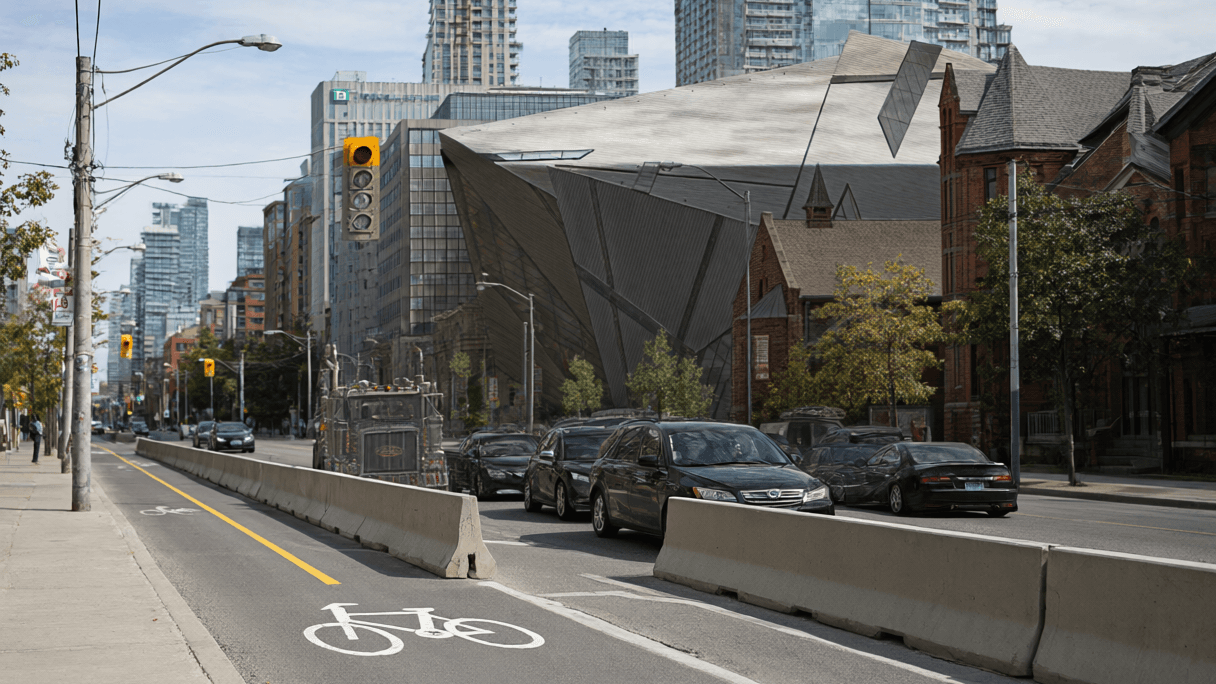
As CBC Toronto first reported, the Ford government is moving forward with plans to remove bike lanes on three major Toronto roadways: Bloor Street, Yonge Street, and University Avenue. This follows an August ruling by the Court of Appeal for Ontario, which reversed a July 2025 lower-court decision and cleared the way for the province to remove 19 kilometres of protected lanes. The authority to do this was first established by legislation passed at Queen's Park in 2024, though the lanes remained in place until now due to legal challenges from groups including Cycle Toronto.
For the province, the math is purely economic. Dakota Brasier, a spokesperson for Ontario’s Ministry of Transportation, told CBC Toronto that the government has a "clear mandate" to fight gridlock, claiming congestion costs the provincial economy over $56 billion annually. Brasier argues that restoring vehicle lanes is the key to getting goods and people moving again. To mitigate the risks, the province is spending $210 million on measures like roundabouts and speed bumps to protect families.
But the people who actually treat the victims of road violence see a different set of numbers. A coalition of roughly 650 health-care workers, including doctors and nurses, recently gathered at University Avenue and Gerrard Street to denounce the plan. Samantha Green, a Toronto family physician and co-founder of Doctors for Safe Cycling, told CBC Toronto that the decision to remove these lanes is "not based on evidence," asserting that bike lanes save lives and are desired by the community.
Even more damning is the revelation reported by CBC Toronto that internal ministry documents, reports, and emails submitted during the 2025 court case showed the government was aware that removing bike lanes might not actually solve gridlock and could increase collisions for all road users.
From the emergency room, the consequences are visceral. Edward Xie, an assistant professor at the University of Toronto and an emergency doctor, told CBC Toronto that physicians already see the fallout of unsafe infrastructure, including potholes and obstructed lanes. He described injuries ranging from broken bones to lacerated internal organs. With emergency departments already overwhelmed, Xie warned that removing these lanes could lead to busier hospitals, resulting in more pain, suffering, and potential deaths.
When the state prioritizes the speed of a delivery truck over the survival of a cyclist or pedestrian, it isn't "addressing gridlock." It is choosing who is expendable on our streets.