
The Cost of Connectivity: West-End Residents Say Metrolinx Prioritizes Timelines Over Livability at Bloor-Lansdowne

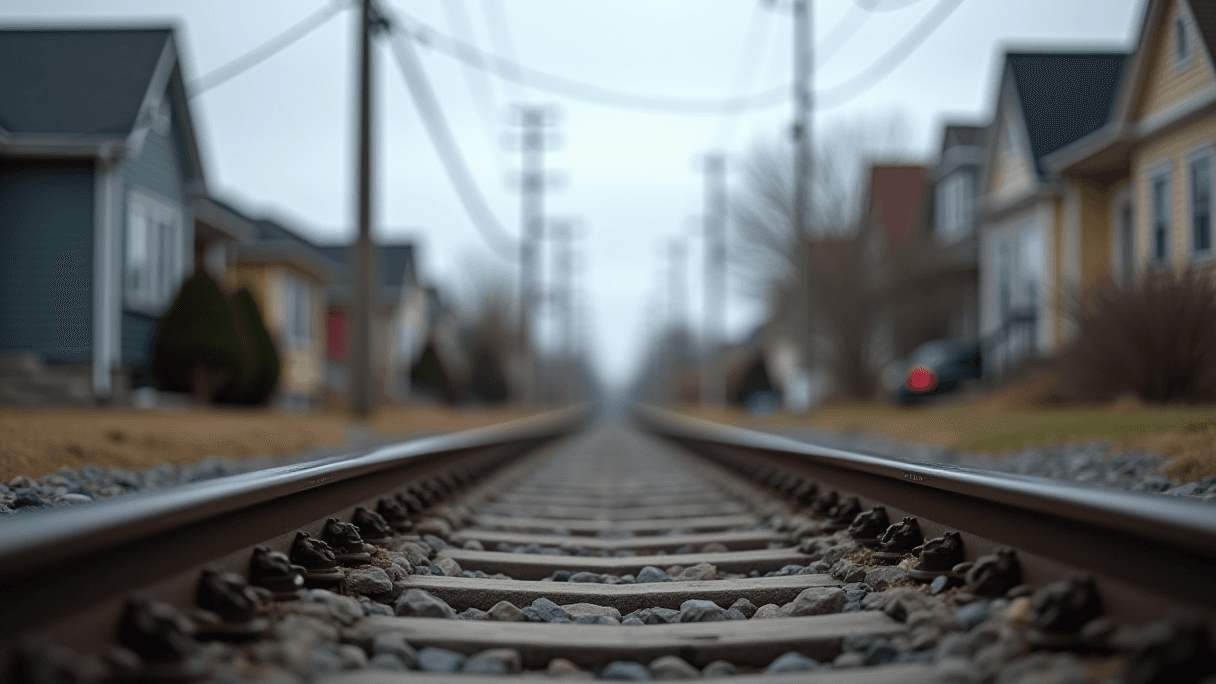
AI-generated image · Bay Street Wire
As the Barrie line expands, west-end residents say Metrolinx is ignoring pleas for noise mitigation, leaving homeowners to face the roar of diesel trains and station bells.
### The Noise of Progress
For the residents living along the rail corridor in west-end Toronto, the promise of expanded transit is beginning to sound less like a convenience and more like a crisis. As Metrolinx pushes forward with the expansion of the Barrie line and the construction of the new Bloor-Lansdowne GO Transit station, a growing number of homeowners claim the agency is prioritizing project completion over the actual livability of the neighborhoods it is carving through.
Reporting from CityNews Toronto, Nick Westoll highlights a deepening frustration among residents who say their repeated requests for noise mitigation measures have been systematically dismissed. The project, which has been under construction for several years, aims to integrate the Bloor-Lansdowne station into the transit network to facilitate future all-day, two-way train traffic. During peak periods, the agency envisions trains arriving every 15 minutes.
While the infrastructure may be a win for the city's transit map, the physical reality on the ground is stark. Paula Heaney, who lives in a century-old building on St. Helens Avenue, described a construction zone that encroaches less than five feet from the entrances of some residential units. Heaney noted that crews have already begun preparing a retaining wall for the future station platform and multi-use path, but the plan notably lacks noise protection.
According to Heaney, the lack of barriers means that GO trains can briefly but completely drown out human conversation. She expressed particular concern over the station's operational noise, noting that the platform will house emergency bells, announcement bells, and the horns that trains are required to use for safety when entering and exiting the station.
### A Failure of Engagement
For those living in the shadow of the new tracks, the issue is not just the noise, but a perceived lack of respect from the agency managing the project. Heaney described Metrolinx's communication as one-way, stating that while the agency provides information, they do not actually listen to feedback or engage meaningfully with the community.
Armin Krauss, a resident on the west side of the rail corridor, has taken his frustration public by hanging a homemade banner calling for the installation of noise walls. Krauss told CityNews Toronto that the environment has deteriorated significantly; where there was once tree cover along the fence to dampen sound and only a single track, there are now two tracks. While he noted that current trains utilize mufflers, he maintains they remain too loud.
Krauss further criticized the agency's community outreach efforts, describing unproductive meetings and a rotating cast of community relations staff that have left residents feeling ignored. In a particularly frustrating turn, Krauss reported that transit agency staff were hand-delivering cards containing links to the project's website shortly after news reports on the issue surfaced, rather than engaging in genuine consultation.
### The 'Half-Measure' Approach
Residents have attempted to find middle ground, but the offers from Metrolinx have been viewed as insufficient. Noah Frank, who lives beside Heaney, revealed that Metrolinx once suggested they would consider covering up to 50 per cent of the cost of a noise wall, provided the residents built it themselves on their own property line.
Frank noted that this was not an official offer and questioned the logic of the proposal. He argued that since Metrolinx is already constructing a wall for the project, the agency should simply integrate a noise barrier into the existing build. According to Frank, any progress has been marginal, consisting of slight improvements in construction timeline notifications, though he noted that even these have faltered and that noise monitoring equipment is not placed adjacent to the affected properties.
### The Diesel Delay
Many residents had hoped that the transition to an electrified Barrie line would solve the noise problem. However, that relief is not imminent. While the Ontario government has awarded a $1.6 billion contract for the first phase of GO Transit train electrification, Metrolinx has not publicly released a timeframe for overhauling the existing infrastructure. This leaves the neighborhood dependent on noisier diesel-powered trains for an indefinite period.
The physical impact of this noise is not merely an annoyance, but a matter of biophysics. Dr. Christopher Bergevin, an associate professor at York University specializing in auditory biophysics, explained to CityNews Toronto that sound is composed of vibrations that are highly transmissible, especially in dense urban environments.
Bergevin noted that while humans can develop a capacity to filter out certain sounds, the pervasive nature of vibration—where buildings touch and air propagates sound—means that quality of life can be significantly impacted. He suggested that the most effective way to reduce these effects is to eliminate the noise sources as much as possible.
As Metrolinx continues to expand the rail corridor, the residents of St. Helens Avenue and the surrounding west-end neighborhoods remain caught between a growing transit network and a disappearing sense of peace.