
The Bloor Street Battle: Ford's War on Urbanism

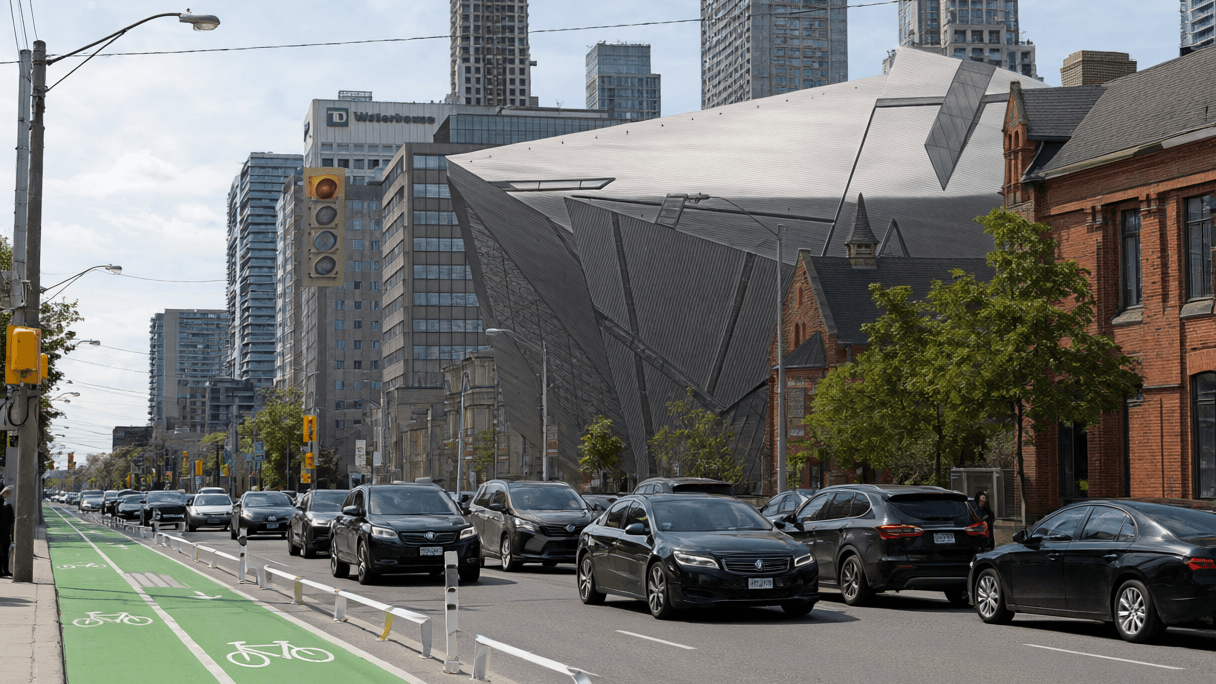
AI-generated image · Bay Street Wire
By overriding municipal authority to rip up protected bike lanes, the provincial government is signaling a political strike against Toronto's urbanist core.
The battle over Toronto's asphalt has shifted from a debate about traffic flow to a stark demonstration of provincial power. As CBC Toronto first reported, the Ministry of Transportation will begin removing bike lanes from a 1.2-kilometre stretch of Bloor Street West in Etobicoke, specifically between Clissold Road and Royal York Road, starting Tuesday. While the Ford government frames this as a necessity for congestion relief, the mechanism of the removal suggests a deeper, more calculated political strike against the city's urbanist vision.
**Opinion: The Political Calculus**
This is not merely about the efficiency of a commute; it is about the erasure of municipal autonomy. By utilizing a ruling from the Ontario Court of Appeal to authorize the removal of 19 kilometres of protected bike lanes—reversing a July 2025 lower-court decision—Premier Doug Ford is effectively dismantling the urbanist infrastructure championed by Toronto's current leadership. The decision to proceed despite a "win-win offer" from Mayor Olivia Chow to restore car lanes while maintaining bike lanes in Etobicoke indicates that the goal is not compromise, but the total reversal of urbanist policy.
**The Clash of Visions**
Mayor Olivia Chow has been explicit in her condemnation, describing the move as "outrageous" and an "affront to the city." According to reporting from CBC Toronto, Chow views the province's intervention as "trampling on local democracy," arguing that the municipal government should retain the right to decide on local affairs, ranging from speed cameras and the Island airport to bike lanes. Chow has vowed that if she is re-elected, she will mobilize citizens to fight back against these removals.
Conversely, the province maintains a focus on motor vehicle throughput. In an email to CBC Toronto, Dakota Brasier, representing Ontario Transportation Minister Prabmeet Sarkaria, confirmed the Oct. 13 start date, stating the province is "restoring motor vehicle lanes." Minister Sarkaria previously asserted in a Sept. 1 news release that the government remains committed to tackling traffic congestion.
**The Data Divide**
The tension is further highlighted by the conflicting interpretations of road usage. Coun. Brad Bradford, a mayoral candidate, argues for a pragmatic approach, citing specific data for the section of Bloor from Resurrection Road to the South Kingsway. Bradford claims that area sees 38,490 cars per day compared to only 197 bikes, suggesting that allocating 50 per cent of the space to a fraction of road users is unsustainable. While Bradford supports bike infrastructure on Adelaide Street, Danforth Avenue, and Richmond Street W., he argues that the Etobicoke stretch is a failure.
However, cycling advocates see the move as a dangerous waste of resources. Michael Longfield, executive director of CycleTO, told CBC Toronto that ripping out these lanes is a "colossal waste of $48 million." Longfield claims that the province's own experts recognize that the removal will not ease congestion and will instead put lives at risk, as there are no viable side-street networks to replace the protected lanes.
As crews begin removing pre-cast concrete curbs and pavement markings beginning Oct. 13, the project serves as a reminder that in the tug-of-war between Queen's Park and City Hall, the province is currently unwilling to yield an inch of the road.