
The AI-Native Y2K: Why Our Hyper-Integrated Infrastructure is Bracing for Collapse

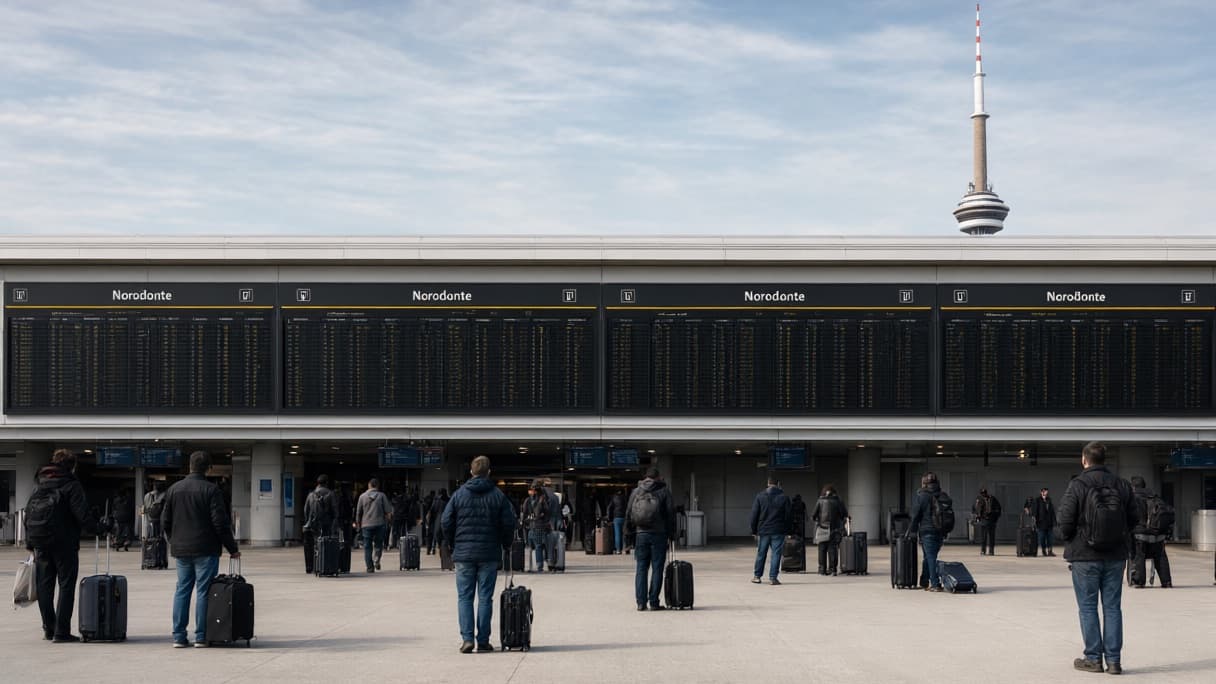
AI-generated image · Bay Street Wire
Recent systemic failures across aviation, finance, and government aren't just glitches—they are the violent friction of legacy hardware meeting AI-speed modernization.
Let's be clear: the recent cascade of systemic failures across the United States is not a series of unfortunate accidents. As TechCrunch first reported, when Apple Pay fails, when NASA's internal communication network goes dark, and when Microsoft suffers an outage that wipes out Outlook, Teams, and Copilot for nearly two days, we are no longer looking at isolated 'tech issues.' We are looking at the fragile failure points of a hyper-integrated infrastructure that is being pushed toward a breaking point.
Reporting from TechCrunch highlights a terrifying pattern. In a mere two-week span, the U.S. witnessed a series of disruptions that hit the very core of daily existence. The most jarring example was the Federal Aviation Administration (FAA) grounding all flights for several hours—a rarity that TechCrunch notes has only happened three times since the events of September 11, 2001.
While President Trump has dismissed these as "individual events" and the director of National Intelligence suggested there is no evidence of state-sponsored terrorism, the timing is too precise to ignore. These collapses followed closely on the heels of "Black October," a date on October 21 marked by a series of cybersecurity incidents affecting Node.js, PHP, and LiteLLM.
**Opinion: The Integration Trap**
From my perspective as a defender, the danger isn't necessarily a single 'AI hacker'—though the fact that hackers recently targeted a blood bank in France and grocery store refrigerators proves the attack surface is expanding. The real threat is the systemic instability created by our desperation to modernize. We are attempting to graft high-velocity AI capabilities onto skeletal legacy systems that were never designed for connectivity, let alone security. We are essentially building a skyscraper on a foundation of sand and acting surprised when the walls crack.
Anusha Iyer, a software engineer and founder of the security startup Corsha, told TechCrunch that these industrial systems were never intended to be securely connected in the manner we are forcing them to be today. Iyer pointed to the FAA outage as a primary example of this friction. Preliminary findings suggest the outage occurred as the FAA attempted to modernize its telecommunications infrastructure; the transition overwhelmed legacy hardware that simply could not keep up with the capacity of modern technology.
This is the "AI-native Y2K." It is the moment where the gap between the old world and the new world becomes an abyss.
Dave DeWalt, who previously served as CEO of McAfee and vice chairman of the CISA Advisory Council for the Department of Homeland Security, told TechCrunch that tools like Mythos are allowing AI to uncover vulnerabilities at a scale and speed never seen before. According to DeWalt, the outages are the "growing pains" of a security system attempting to strengthen itself. He argues that because AI is identifying these flaws so rapidly, enterprises are rushing to patch them before adversaries can, and this surge in patching is what is currently disrupting services.
However, this "rush to fix" is itself a vulnerability. As Virginia Senator Mark Warner, vice chair of the Senate Intel Committee, noted on X, AI is moving faster than the human ability to manage its consequences.
Iyer argues that the fault does not lie with the AI itself, but with a rushed integration process that lacks a clear understanding of operational and cyber risk. To prevent a total systemic collapse, she told TechCrunch that industrial systems must be more tightly segmented and access-controlled, allowing modern systems to be phased in with mitigated risk. DeWalt echoes this need for a more steadfast approach, emphasizing the necessity of rigorous testing and a prioritized roadmap for fixes.
There is a silver lining, if you are a venture capitalist. DeWalt told TechCrunch he expects a surge in new companies focusing on autonomous remediation, safe patch deployment, AI-driven vulnerability management, and the general resilience of critical infrastructure.
But for the rest of us, the lesson is grim. We are operating in a state of precariousness where the very tools we use to secure our systems are accelerating the rate at which those systems break. If we continue to prioritize speed over stability, we aren't just patching holes—we are waiting for the one zero-day that the legacy hardware cannot survive.