
Opinion: The Cost of Corporate Blindness: CN Rail's Betrayal of the Front Line

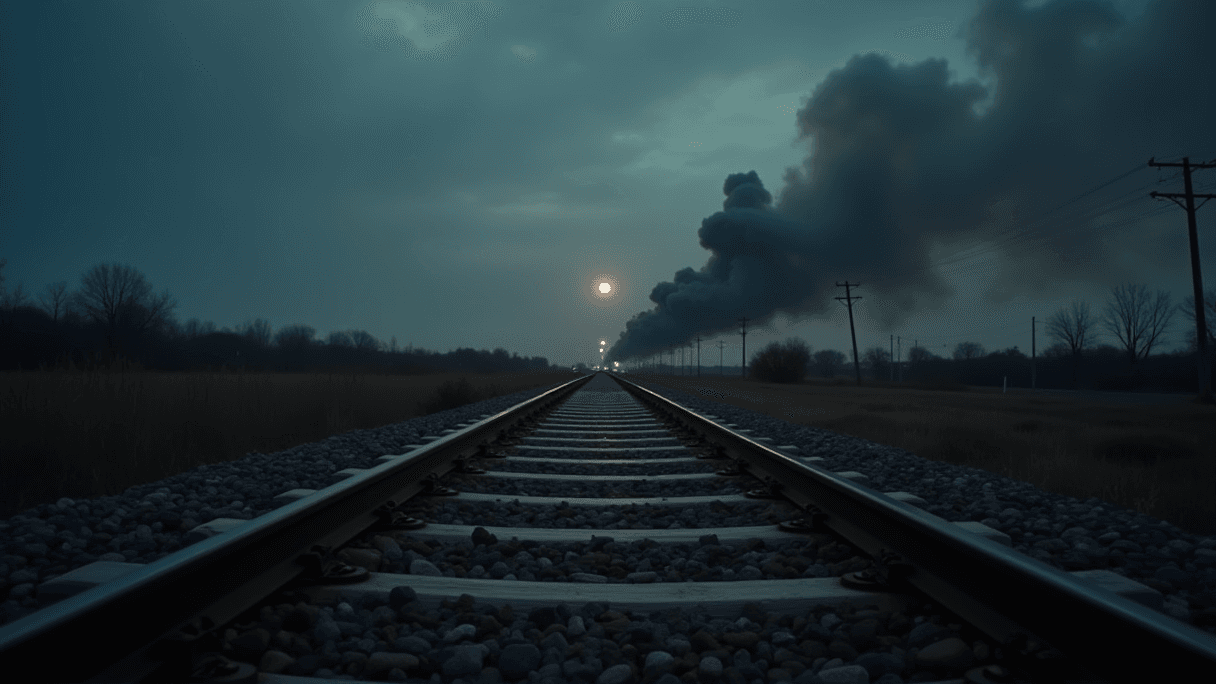
AI-generated image · Bay Street Wire
When a train crew is forced to flee a wildfire on foot, the distance between the boardroom's safety slogans and the reality on the tracks becomes a chasm of negligence.
### The Illusion of Safety
Canadian National Railway Co. (CN) likes to speak the language of corporate responsibility. In a statement released Thursday, the Montreal-based company asserted that the safety of its employees, emergency responders, and the community remains its "top priority." Spokesperson Michelle Hannan reinforced that message Friday, saying that safety is the company's "core value" and that CN would "never compromise the well-being" of its workers.
But for the crew of a freight train near Armstrong, Ontario, those corporate platitudes were meaningless as they found themselves encased in a wall of orange-red flames.
As reported by CBC and Global News, a viral video captured the terrifying reality of the incident. In the footage, a worker is heard pleading with radio operators, stating, "Y'all need to hurry up here. Like, seriously, we're encased in flames now." The crew did not find safety in a corporate policy manual; they found it by escaping on foot through a wildfire that had been raging for five weeks.
### A Calculated Risk
This was not an unpredictable freak accident. According to Paul Boucher, president of Teamsters Canada—the union representing more than 10,000 railworkers—this disaster was entirely avoidable. "Make no mistake, this incident should never have happened," Boucher stated in a news release. He was blunt about the failure of leadership, asserting that "CN should never have sent a train down those lines."
While the suits in Montreal manage the logistics of cross-country hauls, the workers are the ones breathing the smoke. The crew involved in the Armstrong evacuation had to be treated for smoke inhalation, a physical manifestation of the risk they were forced to shoulder.
CN has since attempted to frame the event as a managed crisis, noting that the crew was safely pulled out of the area—located more than 200 kilometres north of Thunder Bay—on Monday. Global News further reported that two other crews were also evacuated from trains stopped by the blazes. While CN commended the crew's courage and professionalism, courage should not be a prerequisite for a shift on the railway. Professionalism is not a substitute for a safe working environment.
### The Regulatory Reckoning
When the corporate veil is lifted, the government is finally starting to ask the right questions. Transport Canada spokesperson Hicham Ayoun confirmed to both CBC and Global News that federal authorities are investigating whether CN broke the law. Specifically, the government is conducting "followup oversight" to determine if the company failed to comply with the Railway Safety Act.
This is not merely a matter of administrative oversight. Transport Canada is working alongside Employment and Social Development Canada to investigate whether health and safety violations occurred. Ayoun warned that Transport Canada "will not hesitate to implement operational restrictions or protective measures when necessary."
Adding to the scrutiny, the Transportation Safety Board is also "gathering information," according to watchdog spokesperson Liam MacDonald, who noted to Global News that it is too early to determine the next steps of their investigation.
### The Bottom Line vs. Human Life
In the wake of the incident, CN suspended rail operations in a portion of northwestern Ontario, halting freight traffic on a mainline track critical for national hauls. To keep the money moving, CN is rerouting traffic through the U.S. upper Midwest, from Duluth, Minnesota, to Sarnia and Windsor, Ontario. As of Friday, Michelle Hannan stated there is "no timeline" for the reopening of the affected Ontario route.
This scramble to reroute highlights the tension between supply chain maintenance and human life. Marc-André Gauthier, the Teamsters union's communications director, said keeping goods moving matters, but protecting workers matters more. Yet, the fact that trains were operating in a zone where fires had been raging for over a month suggests that the "core value" of safety is often secondary to the core value of the bottom line.
Across the region, the devastation is immense. Premier Doug Ford reported on Friday that roughly 190 wildfires are raging across northern Ontario, burning more land than the entirety of last year's fire season. This is a landscape in crisis, yet CN continued to push its trains through the fire.
### A Pattern of Negligence
The failure to protect workers is mirrored by a broader failure of communication and support in the region. Some Indigenous leaders faulted the province's handling of the crisis, pointing to Whitesand First Nation and Namaygoosisagagun First Nation—also known as Collins First Nation—which were forced to evacuate without provincial help.
When the systems designed to protect people fail—whether it is the provincial government failing First Nations or a corporate giant failing its employees—the result is the same: the most vulnerable are left to fend for themselves.
CN can continue to issue statements about its commitment to safety, but the video from Armstrong tells the true story. It is a story of workers abandoned by their employers, forced to run for their lives while the company's leadership watched from the safety of a boardroom. Until the Railway Safety Act is enforced with teeth, and until CN stops treating its workers as expendable components of a supply chain, the "safety first" slogan is nothing more than a lie.