
Data Dive: Portland Street Shift Slashes Vehicle Trips, Shifts Congestion

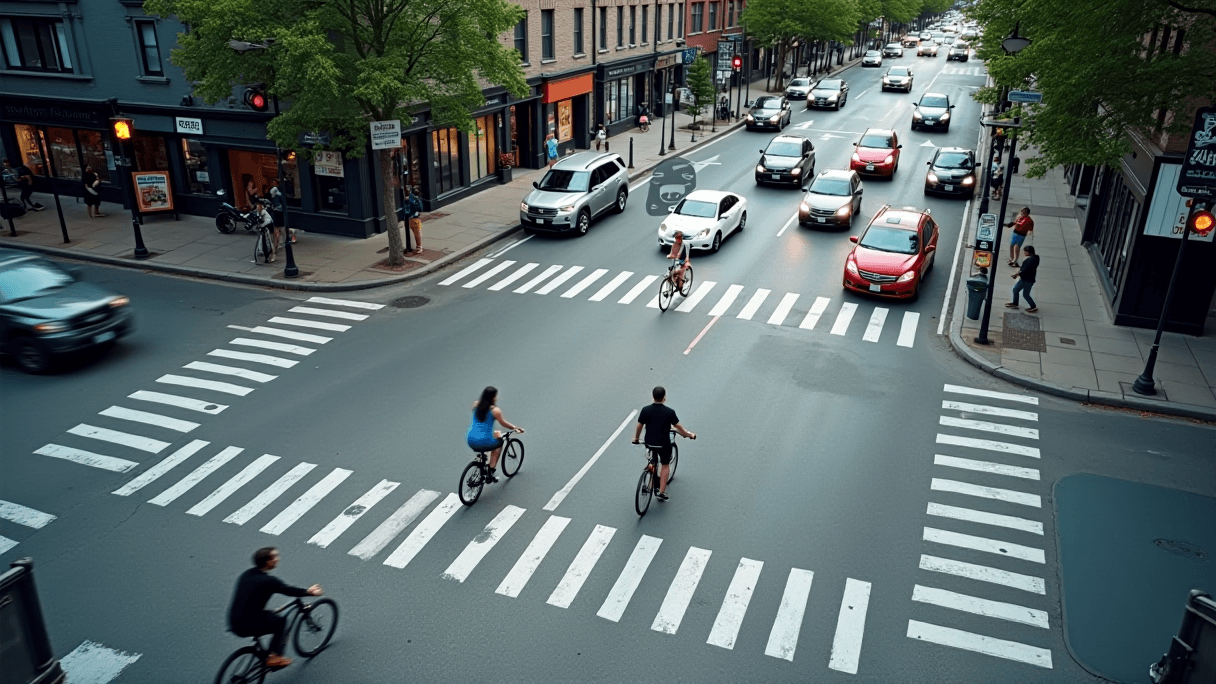
AI-generated image · Bay Street Wire
City of Toronto trip counts show a surge in active transportation at the Wellington and Portland intersection, though officials acknowledge westbound traffic jams.
As first reported by CBC Toronto, the City of Toronto is prioritizing pedestrians and cyclists over motor vehicles at the intersection of Wellington Street W. and Portland Street, and early data suggests the shift is working as intended.
The city implemented infrastructure changes in early June that force drivers on Wellington to turn onto Portland, while those on Portland are diverted onto Wellington. The project also included the installation of a two-way, protected bike lane along Portland.
**The Trip Counts**
To measure the impact, the city compared travel data from Tuesday, June 30, 2026, against data from Tuesday, June 24, 2025. The results show a significant pivot:
* **Intersection Volume:** Vehicle traffic decreased by 52%, while cycling crossings rose by 38% and walking increased by 20%. * **Portland Street Usage:** Pedestrians and cyclists now account for 89% of all trips along Portland, up from 74% in 2025.
Michael Longfield, executive director of Cycle Toronto, told CBC Toronto the changes better connect the city's cycling network, allowing riders to travel from Dan Leckie Way up Portland to reach Richmond and Adelaide streets. Longfield noted that using secondary roads like Portland and Dan Leckie avoided the need for bike lanes on major arterials like Spadina Avenue and Bathurst Street.
**The Congestion Trade-off**
The shift has created friction for motorists. CBC Toronto reports that city staff acknowledged "significant" traffic jams for drivers heading west on Wellington toward Bathurst Street in the weeks following the changes, attributed to a traffic light glitch that caused "unnecessarily extended red-lights."
The city adjusted the lights on July 6, with preliminary data indicating flow improved from four to six vehicles per light cycle to six to eight. City data suggests most drivers who previously used Portland as a shortcut do not live in the area and are now using Spadina or Bathurst.
Matti Siemiatycki, director of the Infrastructure Institute at the University of Toronto, told CBC Toronto that while some drivers may move to adjacent roads, the trade-off is the creation of a "vibrant area" for thousands of people.