
Canada's 950-Fire Crisis: A Systemic Threat to National Stability

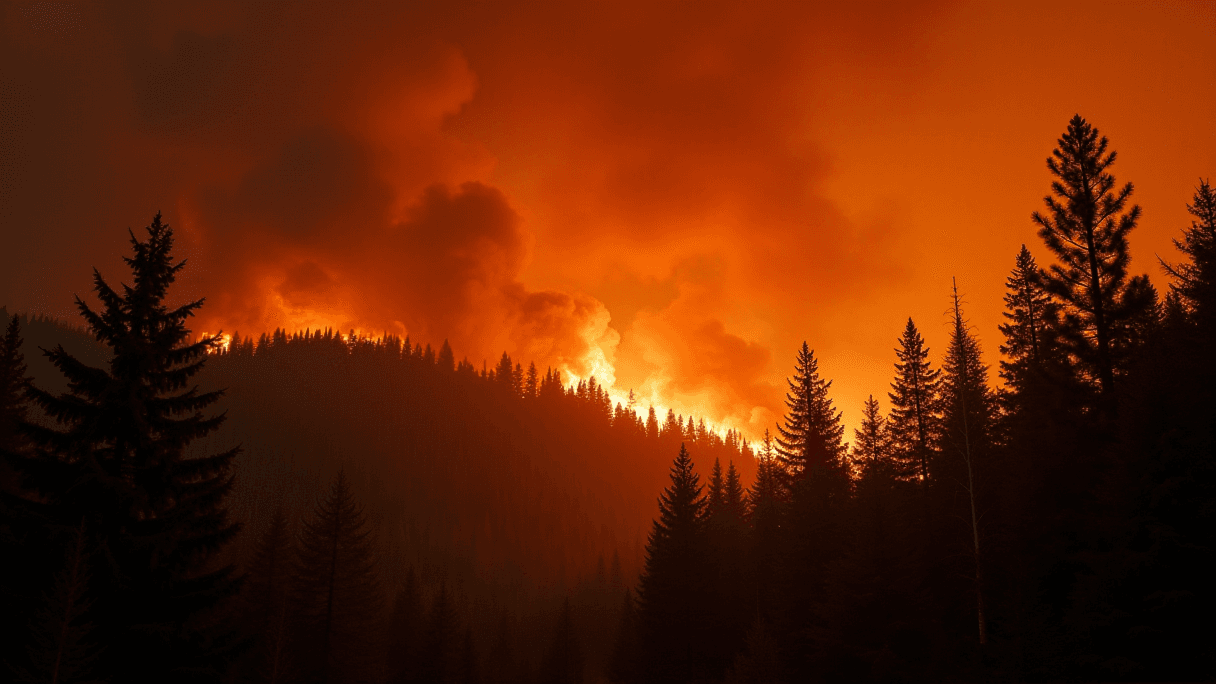
AI-generated image · Bay Street Wire
With nearly 241 blazes out of control and evacuations stretching from Nova Scotia to British Columbia, the scale of current wildfires signals a permanent shift in Canada's environmental and economic risk profile.
### What Happened Canada is currently grappling with a wildfire crisis of staggering proportions. As CityNews Toronto first reported, a national wildland fire summary says more than 950 wildfires are burning across the country. Of these, approximately 241 blazes are classified as out of control.
The devastation is geographically comprehensive. In British Columbia, the BC Wildfire Service reports nearly 115 wildfires, the majority of which were sparked by lightning. In Ontario, nearly 200 wildfires are active—a figure that has already scorched more land than the entirety of the previous year. The crisis extends to the east, where the Nova Scotia Department of Natural Resources is battling an out-of-control fire on Mooseland Road, northeast of Halifax, which is estimated at nearly 14 square kilometres.
### What It Means **Opinion:** The sheer scale of these 950+ fires isn't just a seasonal anomaly—it's a systemic failure of forest management that's now a permanent threat to the national economy. When a single province like Ontario exceeds its total acreage burned from the previous year in a single season, we are no longer dealing with isolated incidents, but a structural collapse of environmental stability.
The human and logistical costs are mounting. In British Columbia, roughly 130 properties near Meadow Lake and Big Bar Lake in the southern Cariboo region were ordered to evacuate on Friday due to a fire spanning 40 square kilometres. In the Northwest Territories, fires forced approximately 1,300 residents of Fort Simpson and 130 from Wrigley to flee in late June; many remain displaced in Yellowknife. Similarly, a fire burning across 172 square kilometres in northern Manitoba forced about 600 people from the O-Pipon-Na-Piwin Cree Nation to evacuate on June 26.
The economic strain is evident in the mobilization of massive state resources. Premier Doug Ford reported that over 80 water bombers and helicopters, along with more than 150 fire crews, are battling Ontario's blazes. In Nova Scotia, the response includes four water bombers and two helicopters from the province, supplemented by two fixed-wing water bombers from Newfoundland and Labrador.
Beyond the immediate fire lines, the systemic nature of the threat is reflected in the air quality. Environment Canada has issued air quality warnings spanning from British Columbia to Quebec, as well as the Northwest Territories. In Manitoba, smoke from local fires and blazes in northwestern Ontario has reduced visibility and air quality, illustrating how these environmental failures create a cascading effect across provincial borders.